
Cornell Univ. Graduate Students Hit UE and GSU Unions with Discrimination Charges for Harassing Religious Objectors to Compulsory Unionism
EEOC Charges: Instead of respecting valid requests for religious accommodation, union officials sent harassing “questionnaires” to illegally interrogate students’ beliefs
Ithaca, NY (June 19, 2025) – Two Cornell University graduate students have just slammed the Cornell Graduate Student Union (GSU) and its parent the United Electrical (UE) union with federal antidiscrimination charges. The students, David Rubinstein and Louie Gold, maintain that union officials are illegally harassing graduate students who submit valid religious objections to paying union dues.
Rubinstein and Gold are both Jewish and believe affiliating with or financially supporting the UE unions conflicts with their sincerely held religious beliefs. The graduate students filed their charges at the Equal Employment Opportunity Commission (EEOC) with free legal representation by National Right to Work Foundation staff attorneys.
In their charges, Rubinstein and Gold explain that they are targets of an illegal practice in which UE union officials harass and interrogate religious objectors rather than comply with Title VII of the Civil Rights Act of 1964, which prohibits employment discrimination, including on the basis of religion.
As their charges explain, rather than comply with their valid requests for religious accommodations, UE union bosses instead sent “questionnaires” containing invasive and legally irrelevant questions to religious objectors. The questionnaires include intrusive demands like, “[P]lease include the name and address of the organization sponsoring the [religious] services you attend and the name of the faith leader(s),” and “How long have you had your religious belief?” The end of the questionnaire indicates that union officials may not even respect a student’s religious objection after completion of the form, stating ominously that “The UE national union will review your religious objection upon receipt and may have follow-up questions” (emphasis added).
Union Officials Ignored Students’ Valid Exercise of Religious Freedom
Rubinstein and Gold argue in their charges that they and other students who received this dubious questionnaire already discharged their legal duties when they informed the union of their objections to paying dues. Title VII of the Civil Rights Act of 1964 provides that objectors must only describe a sincere religious objection to union affiliation, which Rubinstein and Gold both did in letters to the national UE union. Federal law requires union officials to provide a religious accommodation to such objectors. An accommodation often permits the objector to divert an amount of money equal to dues to a 501(c)(3) nonprofit charity instead.
“Both nationwide and on the Cornell campus, the UE, CGSU, and their other campus affiliates have been at the forefront of demonizing Israel, seeking its destruction, and supporting Hamas’s violent and barbaric terrorism against Israel and its inhabitants,” the charges read. “The unions had no objective or bona-fide reasons to doubt the basis for my accommodation request or to question my sincerely held religious beliefs, observances, and practices.”
Because New York lacks Right to Work protections, UE and Cornell GSU union officials are enforcing a contract that requires graduate students to pay union dues or fees just to keep their work. While Title VII creates an exception for those like Gold and Rubinstein who have sincere religious objections to union affiliation, Right to Work states provide even more protection by making union membership and financial support a voluntary choice.
Jewish Graduate Students at MIT Forced GSU and UE to Back Off Illegal Dues Practices
Since 2023, National Right to Work Foundation staff attorneys have assisted dozens of Christian and Jewish graduate students across the country in defending their religious freedom from union forced-dues demands – particularly demands from UE union officials. In 2024, five Foundation-backed Jewish graduate students from the Massachusetts Institute of Technology (MIT) scored religious accommodations that allowed them to pay money to pro-Israel charities instead of to the UE union hierarchy. In a related case for another MIT graduate student, Foundation attorneys secured a settlement that required union officials to inform the entire MIT graduate student body (over 3,000) of their rights under the Communications Workers of America v. Beck Supreme Court decision. Beck permits nonmembers to cut off dues payments for union political or ideological activities.
“This situation at Cornell again shows students and the public at large exactly what GSU and UE union officials’ priorities are: radical political mobilization and agitation, not respecting the individual rights of the students they claim to ‘represent,’” commented National Right to Work Foundation President Mark Mix. “Union bosses may not like it, but federal law is clear that they must comply with valid requests for a religious accommodation based on sincerely held objections to union affiliation, and cannot harass and interrogate those who object to the union’s activities on religious grounds.
“While the battle to preserve the right of religious students and workers to opt out of objectionable union support is certainly important, true reform is needed to ensure that no one is forced to associate with union bosses or their agendas, whether their objection to the union is political, religious, financial, or otherwise,” added Mix.
Following Foundation Legal Arguments, Trump Fires Biden-Appointed NLRB Bureaucrats
The following article is from the National Right to Work Legal Defense Foundation’s bi-monthly Foundation Action Newsletter, March/April 2025 edition. To view other editions of Foundation Action or to sign up for a free subscription, click here.
Foundation constitutional lawsuit first to argue presidents can remove Board members
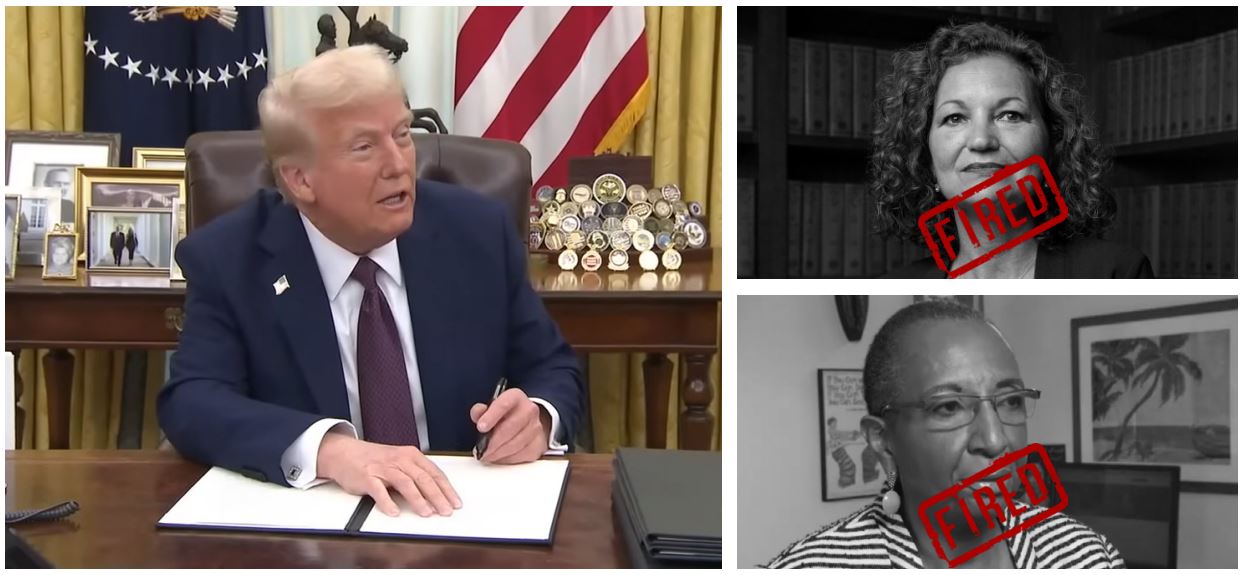
President Trump appears intent on ending union bosses’ reign at the NLRB. One of his first actions was to axe Jennifer Abruzzo and Gwynne Wilcox, both ex-union bosses who constantly sought to beef up their cronies’ powers over employees.
WASHINGTON, DC – Joe Biden, a career lackey of Big Labor union bosses, spared no moment of his administration ensuring that his cronies at the top of America’s largest unions gained power at the expense of independent-minded workers.
Only minutes after being inaugurated in 2021, he began setting the stage for a Big Labor takeover of the federal government: He immediately fired Peter Robb, the general counsel for the National Labor Relations Board (NLRB) during Donald Trump’s first term. With Robb gone, Biden’s acting general counsel quickly quashed multiple National Right to Work Foundation-backed cases that would have otherwise received full NLRB consideration. When Biden filled the general counsel position, he picked Jennifer Abruzzo — a radical ex-Communications Workers of America (CWA) lawyer who was confirmed only because then-Vice President Kamala Harris broke a party-line deadlock in the Senate.
And Biden wasn’t finished. He filled two vacancies on the Board itself with Gwynne Wilcox and David Prouty — who had both worked for the radical Service Employees International Union (SEIU).
Biden’s crusade against worker freedom arguably culminated in the disastrous Cemex Construction Materials Pacific NLRB decision, which gave union officials the power to seize monopoly bargaining power in a workplace without winning a secret-ballot election among employees. The Biden Board also repealed key Foundation-backed reforms that (among other things) stopped union bosses from using so-called “blocking charges” alleging employer malfeasance to stop workers from voting in union removal elections they had requested.
Sudden End of Radical Biden Majority Creates Opportunities for Foundation Litigation
But, just a week after re-ascending to the White House, President Trump took immediate action to undo the damage to worker freedom caused by the historically-radical Biden NLRB. In late January, Trump took the crucial step of giving both Abruzzo and Wilcox the boot. That, combined with the fact that the Senate did not confirm Biden NLRB Chairman Lauren McFerran for another term, means Trump has the opportunity to appoint a pro-freedom majority to the Board before it considers any other cases.
“We hope that this signals the opening of a new chapter at the NLRB, where the agency will fulfill its statutory mandate to protect workers’ right to associate with unions if they choose, but will equally defend their right to refrain from all union activity,” commented National Right to Work Foundation President Mark Mix.
Trump Admin, Others Follow Foundation Lead in Arguing for Structural Board Change
By removing Wilcox, the Trump Administration is relying on arguments made in the Foundation’s groundbreaking cases challenging the structure of the NLRB. Foundation-backed Starbucks employees Ariana Cortes and Logan Karam filed the first-ever federal suit arguing that, as per the Constitution’s separation of powers principles, the president should be able to remove them at-will.
Cortes and Karam’s suit is currently pending at the D.C. Circuit Court of Appeals. Big Labor backers argue that board members like Wilcox have statutory protections that make them removable only in certain circumstances. But Board member protections are constitutionally questionable.
“President Trump made an excellent and decisive move to protect the freedom of American workers. Abruzzo’s and Wilcox’s track records were devastating for independent-minded employees,” observed Mix.
“We’re also encouraged by the Trump Administration’s apparent reliance on National Right to Work Foundation-backed workers’ cases to affirm the idea that NLRB members — like Wilcox — should be removable by the president at will. “The Foundation still has considerable legal work to do to reverse the damage done by the Biden NLRB, and removing a union partisan like Wilcox from the Board is just the first step towards restoring the rights and freedoms of workers opposed to union affiliation,” added Mix.
Full Foundation Action January/February Newsletter Now Online
All articles from the January/February 2025 issue of Foundation Action are now online.
In this issue:
- Dartmouth, MIT, Vanderbilt Graduate Students Challenge Forced Unionism
- Chicago 911 Operators Notch Another Janus Victory Over IBEW
- Philly-Area Manufacturing Employees Triumph Over UAW Intimidation Campaign
- New York Farmworkers Seek to Challenge ‘Card Check’ & Uproot UFW Union Bosses
- Michigan Security Guards Overwhelmingly Vote to End Union Bosses’ Forced-Dues Power
- Austin Worker Files 5th Foundation-Backed Lawsuit Arguing NLRB Violates US Constitution
Netflix Spy Kids Production Driver Demands Review From Federal Labor Board in Case Challenging Teamsters Discrimination
Texas-based driver exposes “hiring hall” scheme that operates in violation of federal law
Austin, TX (June 9, 2025) – Jeff Norris, a transportation employee for Texas-based Netflix streaming productions like Spy Kids: Armageddon, is asking the National Labor Relations Board (NLRB) to review an administrative law judge’s (ALJ) ruling in his case. Norris is charging Teamsters Local 657 union officials with discriminating against employees who have abstained from formal union membership and against union members who have spoken out against union officials’ agenda. Norris is receiving free legal aid from the National Right to Work Legal Defense Foundation.
Norris’ filing attacks Teamsters Local 657 union bosses’ “hiring hall” arrangement, in which they refer production drivers for jobs based on various “lists” that divide employees up by, among other things, member vs. nonmember status. Norris contends that prioritizing the hiring of union members over nonmembers is a form of discrimination that the National Labor Relations Act (NLRA) forbids.
Evidence presented during trial showed that, using this arrangement, it was virtually impossible for a nonmember to he hired for a driver job before a member.
Netflix Driver’s Brief: Workers Targeted by Teamsters Union’s Discrimination Deserve Compensation
The ALJ decision now under review by the NLRB agreed with Norris on his discrimination argument. However, Norris’ newest filing seeks to counter Teamsters lawyers’ position that the NLRB should reverse that holding. The brief also demands a ruling that all employees who experienced discrimination under this “hiring hall” scheme receive compensation, a form of relief that the ALJ puzzlingly decided not to grant.
Norris – whom Teamsters Local 657 President Frank Perkins sought to have booted out of the union – is also taking exception to the ALJ’s ruling that Perkins did not discriminate against Norris by seeking his removal.
Norris, who has been a longtime critic of Teamsters Local 657 leadership, argues that the expulsion attempt “was not the result of a good faith attempt to enforce the Union’s constitution and bylaws,” but involved trumped-up charges designed to punish him for speaking out and filing charges against the union. Similarly, Norris is contesting the ALJ’s rejection of his argument that Teamsters officials slow-walked referring him for a job on Spy Kids: Armageddon due to his advocacy against union bosses’ schemes.
Foundation staff attorneys have recently aided several groups of workers in efforts to challenge malfeasance by Teamsters union officials or vote the union out completely. These include truck drivers in California and Georgia, Frito-Lay warehouse workers in Ohio, metalworkers in San Diego, nurses in Michigan, and many more. Across the country, workers’ desire to exercise their right to vote out unpopular union bosses is increasing: Worker-filed petitions seeking union decertification votes are up more than 50% from 2020, according to NLRB data.
“While it’s all too common to see union officials use their government-granted exclusive ‘representation’ powers to discriminate against workers who decide not to be members, members who expose illegal union boss activities or otherwise question union boss misdeeds are also frequent targets of union abuse,” commented National Right to Work Foundation President Mark Mix. “Netflix production drivers who are ready, able, and willing to help bring stories to the silver screen don’t deserve to be passed over simply for being at odds with union leadership, or because they choose to exercise their right not to affiliate with a union under Texas’ popular Right to Work law.
“We’re proud to help Mr. Norris in his legal battle to ensure that dissident union members and workers who refuse to associate with the Teamsters are not illegally targeted by union bosses,” added Mix.
National Right to Work Foundation Attorney to Appear Before U.S. House in Hearing on Labor Board Reforms
Aaron Solem will call for demise of coercive Biden-era policies
Washington, DC (June 11, 2025) – In a hearing today, veteran National Right to Work Foundation Staff Attorney Aaron Solem will testify before the U.S. House Committee on Education and the Workforce’s Subcommittee on Health, Employment, Labor, and Pensions. He will discuss the reforms needed to reverse the ways the National Labor Relations Board (NLRB), especially under the Biden Administration, rigged the rules to promote union boss power at the expense of the rights of independent-minded workers.
During a hearing titled “Restoring Balance: Ensuring Fairness and Transparency at the NLRB,” Solem will discuss how current NLRB rules allow union officials to corral and keep workers in union ranks without a vote, and let union officials force workers to subsidize union ideological activities. Solem, who has a thirteen-year career of defending workers from union coercion before the courts and administrative agencies like the NLRB, will be urging several reforms to protect workers’ individual rights.
Solem will appear as an expert witness at the hearing chaired by Georgia Congressman Rick Allen. Also appearing on the witness stand will be Jennifer Abruzzo, a former high-ranking lawyer for the Communications Workers of America (CWA) union and ex-General Counsel of the Biden NLRB, who during her time at the agency pushed to make it more difficult for workers to escape union control.
“These are anti-employee policies because they cancel worker choices and replace them with decisions made by unions and the government,” Solem’s written testimony reads. “President Trump won reelection because he was the candidate who listened to employees. The Board should follow in those footsteps by pursuing a truly pro-employee agenda. This agenda would put power in the hands of workers—not unions or employers—— to decide whether they want to be represented by a labor union.”
Biden-Era NLRB Policies Stripped Workers of Right to Exit & Defund Unwanted Unions
Solem’s written testimony breaks down several policies advanced by the Biden NLRB that strip workers of their right to vote themselves free of unwanted union influence. Among these are the “blocking charge” policy, which “allows unions to unilaterally block [union] decertification elections just by filing a charge against an employer, no matter how meritless it may be,” and the so-called “voluntary recognition bar,” which prevents workers from requesting an election to remove a union after union officials gain power through the unreliable “card check” method. Card check abandons the security of a secret-ballot union vote and instead relies on union authorization cards collected by union officials from workers – often through coercive tactics.
Solem also urges the NLRB to “follow Supreme Court precedent and require non-member employees to opt-in to paying for union political expenditures.” As it currently stands, employees who are not union members must “jump through several procedural hoops” to pay a reduced amount of union dues that excludes expenses for union political activities they may staunchly disagree with. The right to pay this reduced amount is enshrined in the Foundation-won CWA v. Beck Supreme Court decision, but current NLRB policies don’t sufficiently protect it.
Freedom vs. Coercion for Workers on Display
“At this hearing, House members will see two starkly differing visions for American workers,” commented National Right to Work Foundation President Mark Mix. “Aaron Solem will advocate for a future where workers can decide for themselves whether or not a union in their workplace is right for them, while Jennifer Abruzzo will double down on granting union officials sweeping coercive powers to impose their will on working people.
“American workers, who are affiliating with unions at near-record-low numbers and overwhelmingly support voluntary and not forced unionism, deserve to have an NLRB where their individual rights are protected and not ceded to union officials and their political cronies,” Mix added. “The incoming Trump NLRB should relegate the cynical, top-down, forced-unionism approach of Jennifer Abruzzo and the Biden NLRB to the dustbin of history, and empower workers by protecting their individual freedoms.”
Right to Work Foundation Submits Legal Brief Opposing Biden “Project Labor Agreement” Rule for Federal Construction Projects
Amicus brief at Eleventh Circuit Court of Appeals exposes rule as discriminating against nonunion workers and contractors in violation of Constitution
Atlanta, GA (June 4, 2025) – The National Right to Work Legal Defense Foundation filed an amicus brief in Associated Builders and Contractors v. General Services Administration, a federal case that concerns the legality of the Biden Administration’s edict ordering federal agencies to contract only with unionized firms on most federal construction projects.
The Foundation’s brief explains that such arrangements, also known as “Project Labor Agreements” (PLAs), violate both the Constitution and conflict with federal law by discriminating against workers and employers who have chosen not to associate with a labor union. The case is currently pending at the Eleventh Circuit Court of Appeals in Atlanta.
“Foundation attorneys have represented [employees] in cases to protect their right to refrain from subsidizing unions,” the amicus brief reads. “The Foundation has an interest in this case because it concerns whether the federal government can lawfully require construction workers to abide by union project labor agreements (PLAs) to work on certain federal projects.”
Biden PLA Order Violates Constitutional Rights of Workers and Employers
The amicus brief contends that the Biden Administration’s PLA mandate contravenes the Constitution in a number of ways, including by “forc[ing] workers into a mandatory agency relationship with a union” under which union officials become their sole “voice” on workplace issues. The brief cites both the Supreme Court’s decision in the Foundation-won Janus v. AFSCME case and similar Eleventh Circuit precedent, which hold that workers’ First Amendment right of free association is violated by compulsory union “representation” for employees who don’t want and never asked for a union.
The Biden Administration’s PLA mandate is also inconsistent with federal law, the amicus brief maintains, because it requires employers and unions to enter into labor contracts with one another. According to the brief, this is a power that the National Labor Relations Act (NLRA), which governs private employers, denies to the federal government. The Federal Property and Administrative Services Act (FPASA), which controls federal contracts, “does not empower federal agencies to take actions that are impermissible under the NLRA,” the brief says.
Foundation Comments: PLA Rule Is ‘Naked Political Payback’
The Foundation submitted comments opposing the Biden Administration’s rule in 2022, exposing that “[t]here is no legitimate legal or policy basis for forcing employees and contractors to abide by union-only PLAs to work on major federal construction projects,” and that the executive order was “naked political payback by the current administration to its union supporters.”
“The Biden Administration’s PLA mandate is a slap in the face to nearly 90 percent of American construction workers, who have chosen not to affiliate with a union,” commented National Right to Work Foundation President Mark Mix. “It also forces taxpayers to pick up the tab on the enormous costs of inefficient union work rules.
“Nonunion employers and construction workers who refrain from union membership deserve a fair shake at working on important federal projects. The Biden Administration’s bald-faced attempt to enrich its union boss allies is illegal in a multitude of ways and should be blocked immediately,” Mix added.
Farmworkers in NY and CA File Federal Challenges Against Statutes Letting Union Bosses Seize Control Without Employee Vote
Workers contend that “card check” unionization method leads to false claims of majority union support, intimidation, and constitutional violations
Washington, DC (May 27, 2025) – Agricultural workers from New York and California have just filed federal complaints to challenge laws in both states that permit United Farm Workers (UFW) union officials to force them under union control using highly suspect tactics. Both sets of workers are receiving free legal aid from National Right to Work Legal Defense Foundation staff attorneys.
In New York, farmworkers Ricardo Bell and Jean Fenel Estrame, who work for Porpiglia Farms in Marlboro and Cherry Lawn Farms in Sodus respectively, are challenging the so-called Farm Laborers’ Fair Labor Practices Act (FLFLPA). In California, Wonderful Nurseries employees Claudia Chavez, Maria Gutierrez, and 18 others are challenging portions of the California Agricultural Labor Relations Act (ALRA).
The New York agricultural employees are challenging the FLFLPA because, among other things, it lets union officials sweep to power through the coercive “card check” unionization method. The California farmworkers assert that the ALRA forces employees and employers alike to accept government-mandated union contracts after such coercion has occurred, and challenge card check itself in a similar state court case.
The card check process lacks the security of a secret ballot vote, and exposes workers to intimidation and manipulation from union officials who seek to collect enough cards to claim “majority support” among workers. Under the rules of both California’s Agricultural Labor Relations Board (ALRB) and New York’s Public Employment Relations Board (PERB), a union that presents the agency with cards obtained from a majority of workers immediately gains certification as the workers’ monopoly bargaining agent.
Charges of improper behavior in obtaining this status, including union lies and coercion while collecting cards, can only be dealt with after the union is certified – if at all. Further, under both statutes, certification starts a countdown to a government-imposed union contract that can trap workers in union ranks for years.
Even worse, Bell and Estrame’s complaint argues that New York’s FLFLPA violates the U.S. Constitution because it lacks basic provisions to guard workers from union boss malfeasance. The statute “does not require that unions fairly represent employees, does not give employees a right to refrain from union activity, and does not give employees a right to file unfair labor practice charges against a union,” the complaint says.
In the Wonderful Nurseries case, the U.S. District Court for the Eastern District of California permitted the 20 employees to intervene in a lawsuit against the ALRB. The employees’ current complaint was then filed on May 19. Meanwhile, in New York, Bell and Estrame filed a motion on May 21 seeking to intervene in a suit in which the New York State Vegetable Growers Association, Porpiglia Farms, and other farm operators are challenging the FLFLPA.
Workers Challenged Union’s Rise to Power Through Deceitful Techniques
Wonderful Nurseries employees sought to intervene in a case challenging UFW bosses’ card check organizing campaign at first before the ALRB, after the agency certified the union’s questionable claims of majority support. In unfair labor practice charges before the ALRB, Chavez and Gutierrez described multiple fabrications – and even discriminatory behavior – that UFW union bosses used to get employees to sign authorization cards, including “representing that certain COVID-19-related public benefits available to farmworkers required signatures on union membership cards…that union membership cards were not, in fact, union membership cards to be used in any UFW organizing efforts…presenting to strictly Spanish-speaking discriminatees union membership cards only in English…[and] presenting to illiterate discriminatees union membership cards and misrepresenting their content and/or significance.”
Complaint: NY Ag Labor Statute Also Disrupts Workers’ Immigration Status
In addition to citing issues with card check, Bell and Estrame’s complaint notes that the FLFLPA’s imposition of UFW bargaining control over them interferes with Bell’s legal status in the country under the H2-A agricultural visa program. “The inclusion of H2-A employees in the FLFLPA statutory scheme and in bargaining units certified by PERB under the statute is preempted by the federal government’s general power to regulate the field of immigration…” the complaint says. According to the complaint, that overreach by the NY statute violates the Supremacy and Contract Clauses of the U.S. Constitution.
“These farmworkers from New York and California are challenging the use of so-called ‘card check’ organizing campaigns in the agricultural sector. But they really speak for countless workers across industries who have faced intimidation, harassment, and other rights violations during card check campaigns just so union officials can seize bargaining control over them and collect dues,” commented National Right to Work Foundation President Mark Mix. “Workers everywhere in the country should have the right to vote in a secure secret ballot election on whether they want a union. And, just as importantly, they should have a right to refrain from union activity and challenge union boss misdeeds if a union they oppose does gain control over them. Card check is a process designed to trample workers’ individual rights.”
Austin Worker Files 5th Foundation-Backed Lawsuit Arguing NLRB Violates US Constitution
The following article is from the National Right to Work Legal Defense Foundation’s bi-monthly Foundation Action Newsletter, January/February 2025 edition. To view other editions of Foundation Action or to sign up for a free subscription, click here.
Case joins others for employees nationwide arguing Labor Board’s structure is illegal
Dallas Mudd helps connect people with the social services they need, and his and many other workers’ ability to do their important work shouldn’t be stymied because unaccountable NLRB bureaucrats are forcing union “representation” on them.
AUSTIN, TX – In November, Dallas Mudd, an employee for online social service coordination platform Findhelp, filed a federal lawsuit against the National Labor Relations Board (NLRB) on the grounds that the agency’s structure is unconstitutional. Mudd’s case, filed in the U.S. District Court for the Northern District of Texas, is the latest in a series of legal actions by National Right to Work Foundation staff attorneys for employees challenging the NLRB’s authority.
Mudd’s case comes after he filed a decertification petition with the NLRB, seeking a vote to remove the Office & Professional Employees International Union (OPEIU) from his workplace. However, NLRB officials blocked the vote, disenfranchising Mudd and his colleagues on the basis of unproven charges union bosses made against Findhelp. Mudd appealed the decision to the full NLRB in Washington, D.C., while also filing a federal lawsuit to challenge NLRB members’ removal protections.
Shortly after the lawsuit was filed, Mudd’s Foundation attorney also asked the Northern District Court of Texas to issue a preliminary injunction stopping the NLRB from adjudicating his appeal until the issue of the NLRB’s constitutionality is resolved. Mudd argues that he is suffering ongoing and irreparable harm by being forced to navigate a statutory process before an agency that he claims is unconstitutionally structured.
Constitutional Challenge: A Broader Legal Campaign
Meanwhile, in its own case against the NLRB, Findhelp has successfully secured an injunction against the NLRB in a federal district court making arguments similar to those raised by Mudd.
Mudd’s lawsuit follows four other constitutional challenges backed by the National Right to Work Foundation, targeting the NLRB’s structure. This includes a case for New York Starbucks employees Ariana Cortes and Logan Karam, who filed the first constitutional challenge to NLRB Board Member protections.
Their case is currently being briefed at the D.C. Circuit Court of Appeals, but since their groundbreaking lawsuit, numerous major employers have utilized the arguments first made in federal court by Foundation staff attorneys to challenge the radically pro-union boss BidenHarris NLRB.
“Independent-minded workers should not be forced to depend on biased agencies staffed by bureaucrats who exercise power in violation of the Constitution,” said National Right to Work Foundation Vice President Patrick Semmens.
“The Constitution does not permit a powerful federal agency to operate as the judge, jury, and executioner without proper oversight.
“Contrary to the wishes of Big Labor bosses, federal labor law is not exempt from the requirements of the U.S. Constitution,” added Semmens.
Hundreds of Sunoco Logistics Drivers Across TX, OK, LA, and NM Free Themselves From Steelworkers Union
Majority of drivers across large work unit backed petition to send USW union bosses packing
Washington, DC (May 20, 2025) – Crude oil drivers for Sunoco Logistics Partners (also known as Energy Transfer) have successfully forced unpopular United Steelworkers (USW) union bosses out of their work unit. The victory for workers comes after Jay Fifer, a driver for the oil transportation company, gathered signatures from the majority of his coworkers on a petition demanding that Sunoco Logistics officials end their recognition of the USW union as the majority “representative” of the drivers.
The National Labor Relations Board (NLRB) acknowledged Sunoco Logistics’ withdrawal of recognition from the USW union on May 12. As the result of Fifer and his coworkers’ effort, over 420 drivers from around 30 Sunoco Logistics facilities across Texas, Oklahoma, Louisiana, and New Mexico are free of the union’s control.
“I’m glad that my coworkers and I were able to band together to force this Steelworkers union out,” commented Fifer. “The union was not a positive force in our workplace, and we are better off without it. I am lucky to live in the Right to Work state of Texas where I could at least choose to stop sending my money to this union while it was still in power, but unfortunately the same can’t be said for all of my fellow drivers.”
The NLRB is the agency charged with enforcing federal labor law in the private sector, which includes administering votes to install (or “certify”) and remove (or “decertify”) unions. Thanks to the 2019 Foundation-won Johnson Controls NLRB decision, workers who want to remove unwanted union officials can also do so by submitting a majority-backed petition asking their employer to stop recognizing the union. If there is a dispute about the petition, the NLRB can administer a secret-ballot vote to test the employees’ opposition to the union.
Fifer lives in Texas, a Right to Work state barring union bosses from enforcing contracts that require employees to pay dues or fees to union officials as a condition of keeping their jobs. Oklahoma and Louisiana are also Right to Work states, but Sunoco Logistics drivers in New Mexico do not have the benefit of Right to Work protections and can be forced to sacrifice part of their paychecks to union bosses or be fired. However, in both Right to Work and non-Right to Work states, federal law lets union officials impose their monopoly “representation” on all workers in a work unit, regardless of whether they support the union or not.
Rank-and-File Oil Truck Drivers Gathered Hundreds of Signatures in Favor of Removing USW
Fifer’s effort to remove the USW union kicked off when he began collecting signatures on a petition asking the NLRB to administer a union removal (or “decertification”) vote at his workplace. Fifer easily met the 30% signature threshold needed to trigger such an election under NLRB rules. However, soon after the NLRB scheduled a decertification vote to take place over a range of dates in May, Fifer’s petition gained even more traction and soon garnered support from a majority of the work unit.
Fifer opted to submit his petition to his employer, who withdrew recognition from the USW union in accordance with the Johnson Controls decision. USW union officials are now stripped of their monopoly bargaining power and can no longer enforce bargaining obligations against Sunoco Logistics.
Foundation staff attorneys have helped several groups of workers exercise their right to remove unwanted USW unions within the last few years, including healthcare workers in Minnesota, metal workers in Pennsylvania, chemical employees in Louisiana, building products employees in New Jersey, and more. Across the country, workers’ desire to exercise their right to vote out unpopular union bosses is increasing: Worker-filed petitions seeking union decertification votes are up more than 50% from 2020, according to NLRB data.
“Rank-and-file workers across the country like Mr. Fifer and his fellow drivers don’t enjoy the same structural and legal advantages that union officials do under American labor law. That makes it all the more impressive that he and his colleagues were able to gather signatures across a huge work unit and break free of the Steelworkers union’s control,” commented National Right to Work Foundation President Mark Mix. “American workers’ increasing interest in escaping union ‘representation’ should serve as a reminder to the Trump Administration that it should pursue labor policy that enhances workers’ freedom to escape unwanted union affiliation.”





