
Workers in Missouri and Minnesota Challenge Union Bosses’ Scheme to Coerce Workers into Funding Union Political Activities
Cases against AFSCME, Guards Union, are latest to argue federal law prohibits “window periods” that trap nonmembers in full union dues payments
Kansas City, MO & Bloomington, MN (August 14, 2025) – Tina Delkamp, an employee of Honeywell FM&T in Kansas City, MO, and Meriem LeClair, an employee of Cornerstone Advocacy Center in Bloomington, MN, have each filed federal charges challenging union officials’ policies in their respective workplaces that coerce nonmember workers into funding union political activities. Delkamp and LeClair filed their charges at the National Labor Relations Board (NLRB) with free legal aid from National Right to Work Legal Defense Foundation staff attorneys.
Both charges state that union officials breached federal labor law by demanding that the employees “affirmatively opt-out of paying for political and ideological activities, instead of opting-in to make political and ideological contributions.” Under the Foundation-won Communications Workers of America v. Beck Supreme Court decision, union bosses cannot force workers who have opted out of union membership to pay fees for union political or ideological expenditures.
While the National Labor Relations Act (NLRA) protects workers’ right to abstain from formal union membership, states like Minnesota and Missouri that lack Right to Work laws permit unions to force workers to pay dues or fees just to keep their jobs. However, Beck limits this forced-dues amount to only what union bosses spend on bargaining functions, and these so-called “chargeable expenses” can never include money for union political or ideological activities. In both cases, union officials have attempted to get around Beck by neglecting to inform the employees of their rights.
Unions Can’t Force Funding for Political Activities Automatically
Delkamp’s charges, filed against International Guards Union of America Local 172, state that union officials are unlawfully withholding financial information she needs to verify what she has to pay as a non-member under Beck. Additionally, the charges challenge union officials for telling Delkamp that her inclusion of her employer on emails concerning her Beck rights was somehow a violation of federal law.
“I tried to exercise my right not to fund political activities I oppose, and the union threatened me for it,” said Delkamp. “Union officials shouldn’t be able to take my wages for their partisan activities without asking me first. They need to take responsibility for respecting my rights, instead of making me fight them on it.”
Union officials often neglect to inform workers of their Beck rights, and sometimes don’t even seek worker consent before deducting full dues (including dues for political expenses) from their paychecks. Recent federal charges filed by Delkamp, LeClair, and other workers with free Foundation legal aid give the NLRB an opportunity to enforce a new federal standard that would require union officials to seek clear consent from workers before extracting full union dues payments from their paychecks.
Union Used “Window Periods” to Keep Worker Trapped
LeClair’s charges, filed against AFSCME Council 5, also allege that the union “refused to recognize withdraw of union membership, except during ‘window periods,’” imposing an arbitrary restriction on the exercise of her Beck rights. Union-created “window periods,” in which union members can withdraw membership, are a stonewalling tactic with no basis in federal law.
“I didn’t want my union dues funding political activities I oppose, so I tried to resign my union membership, only for officials to tell me I had to wait,” commented LeClair. “If I have a right guaranteed under federal law, that right should apply all the time, not only on the days and weeks convenient for union bosses.”
“Across the country, Big Labor officials are using legally dubious schemes to force unwilling workers to fund a radical political agenda that is completely contrary to the priorities of most rank-and-file employees,” commented National Right to Work Foundation President Mark Mix. “The best way to ensure workers’ freedom is, of course, through Right to Work protections that make all union payments completely voluntary.
“Until Right to Work is the law of the land, the NLRB needs to step up to protect workers from being trapped in full forced dues, including the portion used for union political activism,” added Mix. “Workers who have already declined formal union membership should not have to also navigate arbitrary ‘window periods’ just to ensure they are not funding union boss political spending.”
Hundreds of Lufthansa Technicians at Rafael Hernandez International Airport Secure Vote to Remove IAM Union
Majority of technicians signed petition demanding union ouster vote; IAM officials used allegations against employer in unsuccessful attempt to block vote
Para leer este artículo en español, haga clic aquí.
Aguadilla, Puerto Rico (August 12, 2025) – Eric Matos, an airplane technician at Lufthansa Technik’s facility at Rafael Hernandez International Airport, has secured an opportunity for him and roughly 200 of his colleagues to vote International Association of Machinists (IAM) union officials out of their workplace. Matos’ success comes after the General Counsel of the National Mediation Board (NMB) in Washington, DC, rejected IAM union bosses’ attempt to block the employees from voting, and scheduled the vote to occur via mail ballot between August 21 and October 16, 2025. Matos is receiving free legal aid from National Right to Work Foundation staff attorneys in defending his and his coworkers’ right to vote.
The NMB is the federal agency responsible for enforcing federal law in the air and rail industries, a task which includes ordering and administering elections to install (or “certify”) and remove (or “decertify”) unions. Under NMB rules, to obtain a vote to decertify a union, workers must submit a petition indicating that at least 50% of similar workers across a “craft or class” under the union’s control want to have such a vote. Matos submitted a petition containing signatures from a majority of his colleagues in order to trigger the decertification election.
The Lufthansa Technik technicians are under the jurisdiction of the Railway Labor Act (RLA), the federal statute that governs labor relations in the air and rail industries. This means that union bosses have the power to enforce contracts that require payment of union dues or fees as a condition of employment, regardless of a state’s or territory’s Right to Work status (Puerto Rico currently lacks Right to Work protections). For that reason, rail and air employees must vote union officials out of their workplaces to avoid pay-up-or-be-fired demands.
“The union has only seen us as a dollar sign from the very first day and they know very well that having us intimidated and divided while feeding us misinformation is an open path for them to obtain that dollar,” commented Matos.
IAM Union Bosses Denied Request for Immunity From Worker Vote
Despite Matos’ submission of a majority-backed decertification petition, IAM union officials made a number of dubious arguments in an attempt to not only stop the technicians from voting, but to immunize the union for a whole year from any employee attempts to eject the union. IAM bosses asked the federal agency to extend by one year the two-year “certification bar” that prevents efforts to oust a union right after it is established at a workplace. The NMB very rarely grants such remedies.
Foundation attorneys argued in a May 2025 brief that the union’s allegations of employer interference – which concerned a supposedly illicit pay raise that Lufthansa gave the technicians – weren’t tested in a federal court. For that reason, the brief said, the allegations couldn’t support the union’s argument that the election should be blocked. In its recent decision, the NMB tossed the union’s request to block the vote and extend the “certification bar,” ruling that “[b]arring extraordinary circumstances, the Board does not take action on allegations of interference until the end of an election voting period.
“[E]ven in cases where election interference is found to have occurred, the remedies the Board imposes to eliminate the taint of any such interference are limited…they do not include the kinds of relief the IAM seeks here,” the ruling continues. In this case, the IAM made the request to block the vote before an election was even approved.
Trump Admin Should Examine Union Election Standards Across the Board
“The NMB was right to reject union bosses’ attempt to prevent Mr. Matos and his colleagues from exercising their right to vote on the IAM’s presence in their workplace,” commented National Right to Work Foundation President Mark Mix. “While this case has worked out in the Lufthansa technicians’ favor, this case shows the kind of legal tactics and maneuvers that union bosses will attempt to frustrate the will of the workers they claim to ‘represent,’ just so they can collect forced union dues.
“The Trump Administration, which is still staffing its federal labor agencies, needs to focus on eliminating barriers to worker free choice, whether those exist in policies at the NMB or at other federal labor boards, like the National Labor Relations Board,” Mix added.
Public Overwhelmingly Opposes Labor Department Proposal to Loosen Union Financial Disclosures
Over 97% percent of comments oppose proposal to let union bosses hide more political spending from workers
The National Right to Work Foundation recently filed detailed comments in opposition to a Department of Labor Office of Labor Management Standards (OLMS) proposed rule to significantly reduce financial disclosures union officials are required to file. With the comment period concluding last week, it is now clear that commenters overwhelmingly agree with the Foundation that the rule should be rejected.
Of 299 public comments submitted, over 97% strongly opposed the rule change.
The full comment submitted by the National Right to Work Foundation can be read here.
The Foundation’s comments note that the rule cannot be justified because workers’ rights will be undermined if union officials are permitted to more easily hide their spending of dues money, including money seized from workers forced to pay dues or else be fired:
“OLMS data for the past year…shows over 7,700 filings from unions with receipts under $450,000 that are located in states that lack Right to Work laws. These unions reported combined annual receipts of over $523 million, annual disbursements of over $514 million, and over 4 million members… The lack of more detailed reporting requirements for these unions therefore harms over 4 million workers by denying them meaningful details…”
These sentiments were echoed by hundreds of Americans, including rank-and-file workers, who are furious with the OLMS for proposing to deprive millions of workers of vital information on how union officials spend their dues payments, especially spending on union political and ideological activities. As over 225 of the comments point out, this change would allow over 850 unions, spending over $200 million annually, to hide their activities from detailed financial disclosure accessible to workers and the public.
Former union members used the public comments to share their personal experiences with union misconduct, and their desire for more accountability:
- A former member of the International Brotherhood of Teamsters shared retaliation he experienced for speaking out about errors in union financial reports.
- A former professor recalled being forced to pay union dues and being coerced into supporting union candidates and policies.
- A former member of the International Brotherhood of Electrical Workers remembers union chiefs spending lavish amounts of money on politicians he would never vote for.
- A former member of the Communications Workers of America felt betrayed by union bosses and urges the Department to make them account for every cent they misuse.
Other detailed comments opposing the rule came from the National Institute for Labor Relations Research, Institute for the American Worker, Yankee Institute, and Coalition for a Democratic Workplace, as well as others.
Of the just seven comments that actually favored the change, a majority were filed by union officials who predictably want more leeway to hide their spending of dues money from the rank-and-file they claim to “represent.”
Among them was the National Education Association (NEA) which unsuccessfully attempted to hide its controversial 2025 handbook from the public just as comments were being solicited.
Meanwhile, union bosses at the AFL-CIO and AFSCME actually argued for even less disclosure to workers than the rule proposed, with AFL-CIO even suggesting that thresholds should be automatically raised every year.
The United States establishes a government of the people, by the people, and for the people. OLMS should reject these union bosses’ personally-motivated requests, and instead listen to the voice of the overwhelming majority calling for this change to be withdrawn.
San Fernando Valley Kaiser Permanente Nurse Hits UNAC Union With Federal Charges for Forcing Nurses to Fund Union Politics
UNAC union officials stated she would be fired if she refused formal union membership and dues payments for political expenditures
Los Angeles, CA (July 18, 2025) – Sarah Warthemann, a nurse at Kaiser Permanente’s branch in Woodland Hills, has just filed federal charges against the United Nurses Association of California (UNAC) union at her workplace. She maintains that UNAC officials threatened that she would lose her job if she did not formally join the union, and have ignored her attempt to exercise her legal right to opt out of paying for union political expenses. Warthemann filed her charges at the National Labor Relations Board (NLRB) with free legal assistance from National Right to Work Legal Defense Foundation staff attorneys.
The NLRB is the federal agency responsible for enforcing federal labor law, a task that includes adjudicating labor disputes between employers, union officials, and individual employees. Section 7 of the National Labor Relations Act (NLRA) protects workers’ right to refrain from participating in or supporting union activities.
Warthemann’s charge concerns her rights under CWA Union v. Beck, a Foundation-won case in which the Supreme Court ruled union bosses could not require those abstaining from union membership to fund union ideological activities just to keep their jobs. The General Motors v. NLRB Supreme Court decision also forbids union officials from requiring formal membership as a condition of employment.
Because California is not a Right to Work state, UNAC chiefs can enforce union monopoly bargaining contracts that require Warthemann and her fellow nurses to pay union dues to keep their jobs, but Beck limits this amount to only the portion of dues that UNAC officials use for bargaining functions. In contrast, in Right to Work states like neighboring Arizona and Nevada, union membership and all union financial support are strictly voluntary.
“The radical political agenda promoted by the UNAC union is something I do not—and should not—be compelled to support,” Warthemann commented. “While I’m required to pay union dues to remain employed at the hospital, that obligation should not include funding extreme political activities. It is both unethical and, in my view, illegal.”
UNAC Union Bosses Snub Both Federal Law and Recent Settlement
Warthemann reports in her charges that a UNAC representative emailed her a union membership form in June, insisting that she “fill this out ASAP. It is a condition of employment.” Warthemann also notes that UNAC bosses have been ignoring her request to exercise her rights under Beck, and have persisted in demanding she pay full union dues. According to the charges, the union flouted other requirements mandated by the Beck decision – including that union officials provide nonmember employees with a financial breakdown of how the union spends employees’ money.
The UNAC union’s failure to follow Beck is especially flagrant in light of an NLRB-approved settlement union bosses recently reached with another Kaiser Permanente Woodland Hills nurse, Jillian Clausi. Clausi also accused the union of Beck violations, and the settlement in her case contains declarations by the union that it will “not charge Beck objectors the full amount of union membership dues,” among other things. This appears to be exactly the misbehavior Warthemann is describing in her new charge.
“It’s no surprise that UNAC union officials – who spent millions of dollars to influence the 2024 California elections – are trying to keep nurses in the dark about their right to stop their money from enriching the union’s political machine,” commented National Right to Work Foundation President Mark Mix. “But workers’ right to say ‘no’ to funding union boss agendas shouldn’t be limited to just politics. No worker should be forced to fund a union hierarchy that has been abrasive or just flat out incompetent while claiming to ‘represent’ workers.
“Ms. Warthemann’s case is Exhibit A in why all American workers deserve Right to Work protections. Union officials must rely on voluntarism – not government-backed force – to gain worker support,” Mix added.
Comfort Systems USA Pipefitters and Welders Win Two-Year Battle to Escape Steamfitters Local 52 Union
Union officials made dubious charges concerning pipefitter who collected worker signatures opposing union, but charges were dropped just before hearing
Montgomery, AL (July 15, 2025) – Brandon Davis and his fellow pipefitters and welders at Montgomery-based HVAC company Comfort Systems USA Mid-South have successfully removed Steamfitters Local 52 union bosses from their workplace. Davis, who spearheaded the nearly two-year struggle to oust the union, received free legal aid from National Right to Work Legal Defense Foundation staff attorneys.
Davis’ effort kicked off in March 2023, when he filed a petition backed by his coworkers asking the National Labor Relations Board (NLRB) to hold a workplace vote to remove (or “decertify”) the union. The NLRB is the federal agency in charge of enforcing federal labor law, a task that includes adjudicating labor disputes and administering elections to install or remove unions.
While Davis’ petition contained more than enough employee signatures under federal law to trigger a union decertification election, he had a backup plan: To avoid any attempts by union officials to use litigation to hold up or cancel the election, he also submitted a copy of his petition to his employer. Under the 2001 Levitz Furniture Co. NLRB precedent, employers can legally withdraw recognition from union bosses as the “exclusive representative” of their employees upon receiving a petition that shows the union does not enjoy majority support among workers – which Davis’ petition did.
Because Davis and his coworkers work in the Right to Work state of Alabama, state law barred Steamfitters union officials from enforcing contracts that required union membership or dues payments as a condition of employment. However, in Right to Work states and non-Right to Work states alike, union officials still have the ability to impose their “exclusive representation” on every worker in a unionized facility, even those who vote against or otherwise oppose the union.
Steamfitters Union Bosses Sought Order Compelling Workers Under Union Control
Comfort Systems stopped recognizing the Steamfitters union in March 2023 based on Davis’ petition. Unfortunately, Steamfitters union officials still tried to trap Davis and his coworkers under their control. Steamfitters union bosses filed a number of unfair labor practice charges against Comfort Systems management in an attempt to elicit an order from the NLRB that would force the company to submit to bargaining with the union – despite the petition showing that the union no longer enjoyed majority support from the workers. One union boss charge even accused Davis of being a manager or being put up to seeking an election, alleging his collection of worker signatures was part of an illegal company plot.
In February 2025, NLRB Region 15 issued a complaint finding merit to the union’s unfair labor practice charges, including the claim that Davis was a member or agent of management. Davis’ Foundation attorneys quickly sought to intervene in the case between the Steamfitters union and Comfort Systems to rebut the union’s allegations. “Should Mr. Davis be denied Intervenor status, an unfavorable determination in this case could destroy the impact of the decertification petition he prepared, i.e., the lawful withdrawal of recognition by his Employer,” read the motion to intervene.
Under pressure from Davis and his Foundation-provided legal team, the NLRB abandoned the allegations that threatened to reimpose the union and agreed to settle all others just three days before a hearing was scheduled to take place. With no remaining challenges to the company’s withdrawal of recognition, Davis and his colleagues are finally free of the Steamfitters union’s control.
“We’re proud to help Mr. Davis and his fellow Comfort Systems employees escape the clutches of Steamfitters union bosses who weren’t standing up for the employees’ interests, but their legal battle should have never lasted this long,” commented National Right to Work Foundation President Mark Mix. “As the Trump Administration selects new NLRB members, it should seek members who will eliminate policies that let union officials seize forced ‘representation’ powers over workers on the basis of unproven allegations. The Board should instead plan to defend equally workers’ right to associate or disassociate with a union as they please.”
Cornell University Graduate Student Files Federal Charges Seeking End to Union Boss Control Over Graduate Students
Student case attacks Obama-era federal labor board ruling that exposed graduate students to union boss power
Ithaca, NY (July 14, 2025) – Russell Burgett, a Ph.D. candidate in chemical physics at Cornell University, has just launched a groundbreaking federal labor case challenging the Cornell Graduate Student Union’s (an affiliate of United Electrical) authority to maintain exclusive representation powers over him and his fellow graduate students.
Burgett, who opposes the union and is not a member, filed his charges at the National Labor Relations Board (NLRB) with free legal aid from National Right to Work Foundation staff attorneys.
The NLRB is the federal agency responsible for enforcing private sector labor law. Burgett’s case is a direct challenge to the Obama NLRB’s 2016 Columbia University ruling, which overturned longstanding precedent and permitted union bosses to gain monopoly bargaining powers over graduate students at private universities like MIT, Columbia, and Cornell.
While union monopoly bargaining schemes in academia were already controversial at the time of the Columbia University ruling, student opposition to the policy has spiked in recent years as union officials have pursued increasingly radical and divisive ideological activities on campuses.
Charges: NLRB Must Reexamine Union Powers Over Students, Including Forced-Dues Mandates
Burgett’s charges assert that Cornell graduate students are not “employees” under the National Labor Relations Act. For that reason, the charges say, CGSU-UE union officials’ attempts to force them to abide by a union contract – including provisions that effectively mandate the students pay union dues or fees to complete essential parts of their graduate programs – violate federal labor law.
Furthermore, Burgett’s charges contend the union contract is illegal because it forbids the university from doing business with students who abstain from union membership or union financial support. Union agreements that require an entity to cease doing business with persons who refuse to associate with the union are a clear violation of the National Labor Relations Act.
“Mr. Burgett’s case is the latest chapter in a continuing saga showing why union bosses’ one-size-fits-all bargaining schemes have no place in academia,” commented National Right to Work Foundation President Mark Mix. “At America’s elite universities, union bosses empowered by the Obama and Biden NLRBs are coercing dissenting students into funding their political radicalism and constant agitation – including Jewish students who have sincere religious objections to the anti-Israel vitriol that campus unions push.
“Forcing students to choose between completing their graduate degrees or affiliating with an ideological group they find unconscionable is antithetical to principles of academic freedom, and Mr. Burgett’s case directly attacks the Obama NLRB’s and Biden NLRB’s flawed rulings allowing such coercion to happen in the first place,” Mix added.
DOJ Attorney Battles Biden Admin Union Power Grab Over Justice Department
The following article is from the National Right to Work Legal Defense Foundation’s bi-monthly Foundation Action Newsletter, March/April 2025 edition. To view other editions of Foundation Action or to sign up for a free subscription, click here.
Foundation attorneys challenge last minute DOJ unionization in violation of FLRA case law
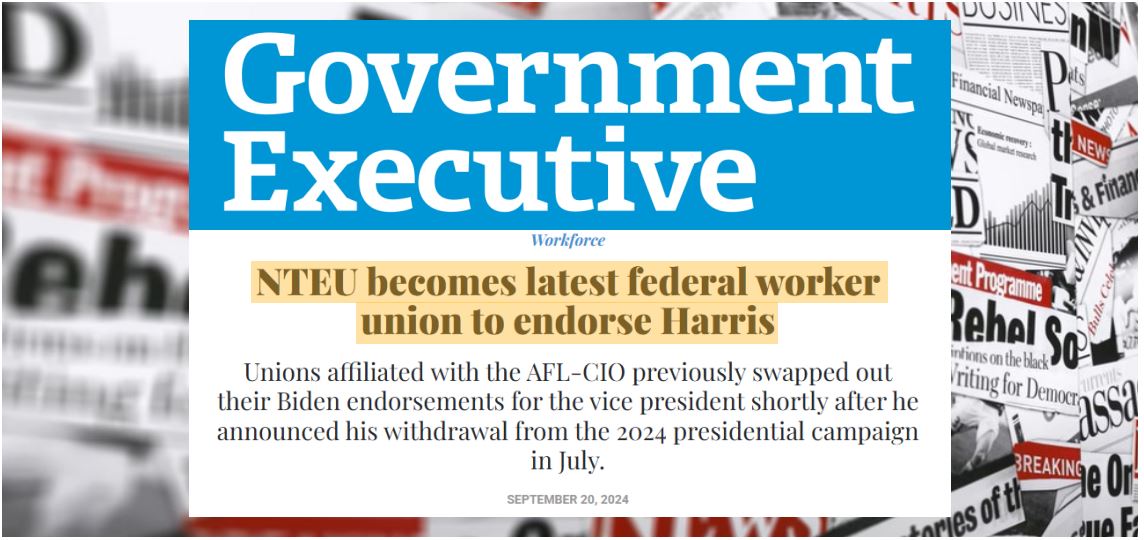
NTEU union bosses backed Kamala Harris for President, but when voters rejected her, NTEU union officials and the Biden-Harris Administration hastily moved to install the union at the DOJ in an apparent attempt to obstruct Trump’s priorities.
WASHINGTON, DC – In states across the country, union officials go to great lengths to gain more political influence, and will often violate established law to do so.
As veteran Department of Justice attorney Jeffrey Morrison is discovering, federal agencies are no exception. Morrison is challenging a last-minute attempt by National Treasury Employees Union (NTEU) bosses to gain monopoly bargaining control over attorneys at both the DOJ Civil Rights Division (CRT, where Morrison is employed) and the DOJ Environment and Natural Resources Division (ENRD).
The unionization campaign was fast-tracked just days after Trump’s November election victory, in an apparent attempt to formally hand NTEU union officials power over the divisions prior to inauguration day. Morrison’s legal action asks the Federal Labor Relations Authority (FLRA) to formally review the actions by the Biden DOJ and NTEU officials. The FLRA is the federal agency responsible for adjudicating disputes between federal employees, union officials, and agencies within the federal government.
Brief: DOJ Holdovers and NTEU Bosses Colluded to Flout Existing Law
Morrison, who is receiving free legal aid from the National Right to Work Foundation, contends in filings before the FLRA that the NTEU’s scheme violates an existing FLRA decision in which the agency ruled that CRT attorneys did not comprise a work unit appropriate for unionization.
DOJ management raised this exact concern about the CRT unit with the FLRA after NTEU union bosses began their campaign, but the DOJ dropped its opposition just days after the November federal elections.
Morrison is asking the FLRA to review the decision of the Regional Director to allow the election to go forward in the CRT and ENRD divisions without properly considering if these divisions are an appropriate unit under the law.
Morrison’s filings (called “Applications for Review”) came after DOJ management and NTEU union officials agreed that the CRT and ENRD were work units appropriate for unionization. His Applications for Review point out that a prior FLRA decision, Antitrust Division, held that CRT lawyers “did not have a separate and distinct community of interest from other DOJ trial attorneys” and for that reason couldn’t stand as a distinct bargaining unit.
“[T]he Authority determined this very unit to not be an appropriate unit…The Regional Director’s failure to comply with current, binding Authority precedent is in error and must be reversed,” the Application for Review says regarding the CRT attorneys. This same argument is applied to the ENRD division because it is similarly situated to CRT in the DOJ hierarchy.
FLRA Failed to Conduct Investigation Into NTEU’s Union Scheme
Morrison’s applications also contend that the FLRA “fail[ed] to conduct an independent investigation into the appropriateness of the unit,” despite the law requiring that the FLRA make such a finding.
“An agency agreeing with a union that a unit is appropriate does not mean that unit is actually appropriate. Agencies, like DOJ here, cannot usurp the Authority’s role in deciding unit appropriateness…” say the Applications for Review.
“Right before power changed hands in Washington, DC, NTEU union bosses and DOJ bureaucrats appear to have colluded to flout longstanding precedent that says Justice Department attorneys cannot legally be unionized division by division,” commented National Right to Work Foundation President Mark Mix.
“The FLRA has ignored established precedent to let this hasty unionization attempt go through, and our attorneys are proud to assist Mr. Morrison in opposing this maneuver.”





National Right to Work Foundation Submits Comments Opposing Proposed DOL Rule Loosening Union Financial Disclosures
Comments: Rule will let huge number of unions escape meaningful scrutiny over how union bosses spend worker funds while providing no tangible benefits
Washington, DC (July 31, 2025) – The National Right to Work Foundation has just submitted comments regarding the Office of Labor Management Standards’ (OLMS) proposed rule to significantly reduce financial disclosures union officials are required to file with the Department of Labor. The comments warn that the slated rule will deprive millions of rank-and-file workers of vital information on how union officials spend their dues payments, especially spending on union political and ideological activities.
Current financial disclosure rules for unions mandate that unions with $250,000 or more in annual receipts file an LM-2 report with the Department of Labor, while unions with less revenue must only submit less-detailed LM-3 or LM-4 reports, both of which consist of only a few pages. The OLMS’ proposed rule would eliminate the requirement to turn in an LM-2 for all unions except those with $450,000 or more in annual receipts, meaning a large number of unions currently subject to LM-2 reporting would only be required to provide substantially less-comprehensive filings.
“The ‘cost’ of the proposed rule—the information that workers and others will no longer be able to learn about unions—is considerable,” the comments say. “The rule’s ostensible ‘benefit’—reducing union reporting burdens—is not supported by evidence and is insignificant…The costs of the proposed rule greatly outweigh its nonexistent benefits.”
New Rule Will Block Millions of Workers From Seeing Basic Details About Union Spending
The comments emphasize the wide impact of the proposed rule, especially among those who work in states that lack Right to Work protections and for that reason can be forced to pay union dues or fees just to keep their jobs. “OLMS data for the past year…shows over 7,700 filings from unions with receipts under $450,000 that are located in states that lack Right to Work laws,” the comments say. “These unions reported combined annual receipts of over $523 million, annual disbursements of over $514 million, and over 4 million members.
“The lack of more detailed reporting requirements for these unions therefore harms over 4 million workers by denying them meaningful details” regarding how union officials spend their hard-earned money, the comments explain.
Much of this omitted information will include details on how much money union officials spend on overhead and administration as opposed to representational activities in the workplace, not to mention what union bosses are contributing to often-divisive political causes. While LM-2 forms let workers quickly see these figures, the comments say, “[t]he proposed rule will deprive workers of this information about many unions because the LM-3 does not include these reporting categories.”
Knowing less about union political spending will also impede workers’ ability to enforce their rights under the Foundation-won Communications Workers of America v. Beck Supreme Court decision, the comments point out. Beck blocks union bosses from forcing nonmember workers under their control to pay for union ideological expenses or anything unrelated to representational activities. The comments point to contributions disclosed on LM-2s to groups such as ActBlue, Black Lives Matter, and the Democratic National Committee that would no longer be disclosed to workers if the proposed rule were implemented.
Comments Debunk Union ‘Burden’ Arguments Cited by OLMS
The comments also reveal that the main impetus OLMS cites for pushing this proposed rule – that the regulatory burden for unions is too large – has very little evidence to support it. An estimate that OLMS put out about the number of hours that the proposed requirements would save unions is “out of date, fails to account for modern…software, and is not even an estimate of the time it takes impacted unions to complete LM-2 reports, but rather is an estimate of the average time it takes all unions to complete LM-2 reports,” the comments say.
The comments conclude by asking OLMS to eliminate the current system of graduated filing thresholds and instead require all unions to file LM-2 reports. “The benefit of this change is self-evident: workers, the public, and the Department will receive more information about union finances, which in turn will lead to more informed workers and deter and uncover more union corruption,” the comments explain.
“America’s top union bosses are routinely caught abusing the funds they demand from millions of workers across the country, all while promoting divisive and often radical political causes at every level of government,” commented National Right to Work Foundation President Mark Mix. “Acting in the best interests of workers means providing more clarity on how employee money is spent, not less.
“Make no mistake: The OLMS’ proposed rule will benefit union bosses at the expense of rank-and-file workers. Every worker deserves to know the basic details of how their money is being spent by those who claim to ‘represent them,’ and the slated rule would deprive millions of workers of what little information they already have,” Mix added.