
Right to Work Attorneys File Final Brief Asking Supreme Court to Take Up Union Boss Religious Discrimination Case
Regular Freedom@Work readers may remember the case of Jeffrey Reed, a Michigan employee fighting to end religious discrimination in his workplace. With free legal assistance from Right to Work attorneys, Reed is asking the United States Supreme Court to review a United Auto Workers (UAW) union policy that forces religious objectors to pay more union dues than workers who object to union activities on secular grounds.
Foundation litigators recently responded to the UAW’s final arguments opposing the Supreme Court granting certiorari and hearing Reed’s case. The Foundation’s brief notes that UAW officials forced Reed to pay an additional $100 premium and 22 percent more dues than workers who object to union activities on secular grounds. UAW members and secular objectors are allowed to pay an amount less than full dues if they wish to withdraw their financial support from the UAW’s political activities. As a religious objector, however, Reed is forced to redirect the dollar equivalent of full union membership dues to a third party charity as a condition of his continued employment.
Foundation attorneys also argue that Reed should not have to be disciplined or fired for failing to pay additional dues for the UAW’s policy to constitute religious discrimination. Because this has serious implications for religious objectors in workplaces across America, several organizations have filed amicus curiae briefs in support of the Foundation’s petition, including a joint brief from the Ethics and Religious Liberty Commission of the Southern Baptist Convention and the General Conference of the Seventh-day Adventists and the Center for Constitutional Jurisprudence. The Foundation’s original petition for a writ of certiorari can be found here, the UAW’s response here, and the Foundation’s final reply brief here.
Although the Supreme Court grants cert to only a few cases each year, Right to Work attorneys are hopeful that the Justices will take up this case to clarify a previously muddled body of law. We anticipate receiving final word on the Court’s decision as soon as early April.
March/April 2010 Foundation Action Now Available Online
The March/April 2010 issue of Foundation Action is now available for download as a PDF. This is the Foundation’s official bimonthly publication that provides an excellent overview of hard-hitting legal actions being taken by Foundation attorneys every day to combat forced unionism. This issue’s top story chronicles the Foundation’s efforts to help Michigan’s home-based child-care providers fight 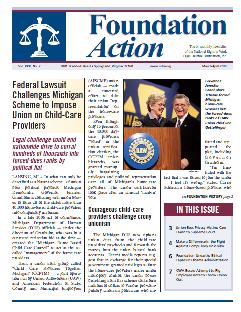 back against Governor Jennifer Granholm’s corrupt government union political payback scheme.
Also in this issue:
- Federal Lawsuit Challenges Michigan Scheme to Impose Union on Child-Care Providers
- Union Boss Privacy Victims Case Taken to Supreme Court
- Make a Difference in the Fight Against Compulsory Unionism
- Foundation Unearths Ethical Lapses in Obama Administration
- CWA Bosses Attempt to Rig Employee Vote to Throw Union Out
In addition to to reading Foundation Action online, you can sign up to receive a free subscription by mail here.
Teacher Challenges School Policy that Discriminates Against Nonunion Teachers during Professional Hearings
Union members receive access to counsel while nonmember teachers aren’t allowed to bring their own attorneys
Miami, FL (April 1, 2010) – With free legal assistance from the National Right to Work Foundation, a Miami-Dade public school teacher has filed unfair labor practice charges challenging a discriminatory policy that prevents nonunion teachers from using representatives of their own choosing during school investigatory interviews.
Shawn Beightol, a veteran chemistry teacher at Michel Krop Sr. High School, was told to report to the Miami-Dade County Office of Professional Standards (OPS) to discuss a possible violation of the school’s email policy last October.
The United Teachers of Dade (UTD) union is the exclusive bargaining agent for the Miami-Dade School District. However, Beightol is a member of the Professional Educations Network of Florida (PENFL), a nonunion teachers association. Although Beightol brought a representative from the PENFL to the October hearing, school officials refused to allow his advisor to participate.
Editorial Boards: Obama’s Discriminatory Union-Only Construction Policy Hurts Workers, Job Providers, and Taxpayers
On Tuesday, the Obama Administration implemented a new policy — initiated by an early executive order signed by President Obama — encouraging federal agencies to adopt so-called "project labor agreements" (PLAs) on large-scale federal construction projects.
Some of the typical conditions demanded by unions in PLAs include monopoly bargaining, forced dues and fees for all “represented” workers, exclusive union hiring halls, and inflexible union work rules which strictly separate job functions into exclusive union jurisdictions based on craft.
The Wall Street Journal strongly criticized the new policy, which effectively discriminates against the 85 percent of all construction workers who are not under union monopoly control. Moreover,
It’s also a rotten deal for taxpayers. White House economist Jared Bernstein blogged that these agreements "significantly enhance the economy and efficiency of Federal Construction projects." In fact, the carve-outs put an end to open, competitive federal bidding, which means higher project costs. They also mean taxpayers must finance the benefits and work rules of union members.
…
Boston’s Big Dig, Seattle’s Safeco field, Los Angeles’s Eastside Reservoir project, the San Francisco airport, Detroit’s Comerica Park—all were built under PLAs marked by embarrassing cost overruns. We’d list more, but newsprint is expensive.
The White House went out of its way to note that the Supreme Court has upheld such agreements in the past, suggesting it has a guilty conscience. In fact, the High Court has never ruled on the legality of these agreements under federal competitive bidding laws. Industry groups are now threatening legal action to defend the rights of workers who will be denied employment for the crime of not sporting Obama-Biden bumper stickers. It’s a fight worth having.
The Washington Examiner likewise denounced the discriminatory policy, noting the National Right to Work Foundation’s objections:
"The Obama administration’s policy is a slap in the face to the vast majority of construction workers who have chosen not to unionize," said Mark Mix, president of the National Right to Work Legal Defense Foundation."Qualified nonunion contractors whose workers have opted against unionization will be locked out from large-scale construction projects. The true purpose of so-called project labor agreements is simple: To impose unwanted union boss control on workers from the top down."
Another factor helps explain Obama’s willingness to sign an executive order that will put millions more tax dollars in union coffers. Mix points out that unions under PLAs typically exact agreements that include requiring contractors to make payments to union pension funds. This is an increasingly urgent issue, as the Washington Examiner’s Mark Hemingway has recently detailed in these pages. According to Labor Department filings, the average union pension has only enough money on hand to cover 62 percent of the benefits it has promised to union members. Pension plans with 80 percent funding are considered "endangered" by federal auditors, while those with less than 65 percent funding are put on the "critical" list. With this latest executive order, it’s clear that Obama intends to give unions on the critical list a massive dose of federal tax dollars to cure what ails them.
On Tax Day, Consider the Forced Unionism Tax
As we struggle to get in our tax returns before the April 15 deadline, it’s worth considering Big Labor’s impact on state and federal taxation. Private sector union membership is dropping dramatically, and union bosses have now turned to federal and state governments to make up the difference. In 2009, more unionized workers were employed in the public sector than by private employers for the first time in history. As a result of these trends, union bosses are more committed than ever to big government and higher taxes to expand the available pool of dues-paying public sector union members. To quote the National Institute for Labor Relations Research:
In mid-December, two of America’s best known labor economists, Drs. Barry Hirsch and David Macpherson, released their analysis of Current Population Survey (CPS) data for the first 11 months of 2009, indicating strongly that last year, for the first time ever, a majority of unionized workers across America were government employees.
Today Big Government, not the private sector, is Big Labor’s bread and butter. That’s why union bosses unabashedly push for higher taxes and bigger government, and seem unconcerned that the policies they advocate will surely slash overall private-sector job growth in future years.
New Right to Work Podcast: How «Project Labor Agreements» Line Big Labor’s Pockets
When Questioned, Public Sector Union Bosses Respond With Threats
With the Police and Firefighters Monopoly Bargaining Bill looming on the horizon, here’s a portent of things to come from the Cal Watchdog blog:
North Bay firefighters launched a boycott of a Napa Valley winery this weekend after its owner criticized their wages and benefits in a letter published in the St. Helena Star. But more than a boycott was launched, as the winery owner has received veiled threats online from some public safety employees, potentially refusing to fight a fire at his home or winery, or save him from choking in a restaurant.
A concerned winery owner has the temerity to point out that public sector union bosses have bankrupted California. In return, he’s threatened by union operatives who say they’ll refuse to fight a fire at his home or place of business. The union militants’ reaction is all the more thuggish in light of the original letter to the editor, which is about as mild as political criticism gets, putting the blame squarely on the politicians:
Napa Valley winery owner Dario Sattui of V. Sattui Winery wrote a letter to the Editor of the St. Helena Star, venting about the benefits and pensions that firefighters receive. In his April 9 letter, Sattui wrote, “I thought I was doing well in the wine business. Had I had any real brains I would have become a firefighter. What a racket they have. While I respect the work they do and the inherent dangers, they are greatly overpaid, work only two days a week (a third of which they sleep) and get to retire at 50 years old at 90 percent of their pay after working 30 years. I don’t blame the firefighters. Good for them for getting as much as they can. The blame goes to the politicians and the government administrators. What do they care? It isn’t their money.”
The skyrocketing costs of public services are an inevitable consequence of public sector unionization, which relentlessly expands government and drives up taxes. Union operatives’ threat to ignore a fire at the winery owner’s home also highlights the dangers of the Police and Firefighters Monopoly Bargaining Bill, which would leave state and local public safety employees at the mercy of Big Labor organizing drives. Once Big Labor bosses are firmly in control of public safety organizations, they’ll have no qualms about leveraging their influence over firefighters and police departments to threaten anyone who dares to question their monopoly bargaining powers.
Gov. Quinn Faces Class-Action Suit for Executive Order Designed to Unionize Home-Care Providers

Gov. Quinn Faces Class-Action Suit for Executive Order Designed to Unionize Home-Care Providers
National Right to Work Foundation attorneys assist home-based personal care providers pushed into union’s forced-dues ranks against their will
Chicago, IL (April 22, 2010) – With free legal aid from National Right to Work Foundation attorneys, a group of home-based personal care providers today filed a class-action lawsuit in federal court against Governor Pat Quinn and union officials for their efforts to force Illinois personal care providers under unwanted union boss control.
The suit stems from an executive order issued by disgraced former-Governor Rod Blagojevich shortly after his election, later codified, in which over 20,000 personal care providers who care for individuals with disabilities were designated as “public employees” of the state of Illinois for the purpose of granting Service Employees International Union (SEIU) bosses monopoly “representation” and forced dues privileges over them.
Following the Rod Blagojevich blueprint of forced unionism, Quinn signed an executive order last June that made an additional 4,500 home-based personal care providers susceptible to unwanted union boss bargaining and political “representation.” Not coincidentally, Quinn received the SEIU union bosses’ political endorsement and support during his recent closely-contested primary campaign for the Democratic nomination for Governor.
The additional 4,500 home-care providers who are not yet under union control soundly rejected union membership by a two-to-one margin in a mail-in vote. However, per Quinn’s executive order, the home-care providers may again be subject to out-of-state SEIU and American Federation of State, County, and Municipal Employees (AFSCME) union organizers making “home visits” attempting to organize the home-care providers through coercive “card check” unionization tactics.
Pam Harris, Gordon Stiefel, and several other home-care providers — with assistance from the National Right to Work Foundation — filed the federal suit on behalf of all of Illinois’s providers unionized by Blagojevich and on behalf of home-care providers threatened by forced unionism as a result of Quinn’s executive order.
“My primary concern is that someone else will be telling me how to best care for my son,” said Harris, who provides personal care for her adult son and is the lead plaintiff in the suit. “Union dues would be a deduction from what we have available to provide for my son’s needs. And then I would be giving my money to a union to exercise their political muscle on issues I may vehemently disagree with.”
Click here to read the whole release.
A copy of the complaint can be downloaded (pdf) by clicking here.
Right to Work Submits Brief Opposing California Project Labor Agreements
National Right to Work staff attorneys have filed a formal amicus curiae brief supporting an appeal in US District Court that challenges a California project labor agreement (PLA) that gives construction union officials new tools to coerce employees and employers who look to bid and perform state-funded construction projects.
Arguing that a PLA between the Rancho Santiago Community College District and a union illegally discriminated against construction workers who exercise their right to refrain from union membership, Foundation attorneys are defending the interests of the vast majority of construction employees in California who have opted against unionization.
Rancho Santiago and the Los Angeles/Orange Counties Building and Construction Trades Council (CTC) union entered into the PLA in 2004, which effectively precluded nonunion apprentices and contractors from working on over 50 construction projects funded by the public agency worth over $300 million. The Foundation-supported appeal challenges this and similar policies to open up the bidding process to all construction workers and contractors.
Will Former SEIU Lawyer and Current NLRB Member Craig Becker Adhere to His Ethics Pledge?
Here’s an update on National Right to Work’s ongoing effort to hold Big Labor-affiliated Obama appointees accountable.
Following the initial round of filings, National Right to Work Foundation staff attorneys have now filed supplements to their motions asking National Labor Relations Board Member Craig Becker to recuse himself from pending cases. In addition to the former SEIU and AFL-CIO union lawyer’s clear bias and hostility toward the Foundation, Becker’s signed Ethics Pledge should preclude his participation in cases in which he and his clients had direct involvement. The relevant portion of the Ethics Pledge:
I will not for a period of 2 years from the date of my appointment participate in any particular matter involving specific parties that is directly and substantially related to my former employer or former clients, including regulations and contracts.
In one of the cases in which Becker should recuse himself, SEIU affiliate Service Workers United have asked the NLRB to overturn the landmark 2007 decisions Dana Corp. Won by Foundation attorneys, Dana held that workers have 45 days to demand a secret ballot election to toss out an unwanted union after the union achieved monopoly bargaining status through the intimidating card check process.
But Becker actually submitted a legal brief to the Board on behalf of the AFL-CIO and UAW in that very case. It would be highly unethical for Becker to rule on the validity of a prior Board case in which he served as counsel.
While his controversial nomination was stalled in the Senate, Becker also promised to recuse himself from cases involving his former employer, the radical SEIU union. The real test of his ethics, however, comes with cases involving SEIU affiliates and locals.
As Foundation attorney Glenn Taubman explains in one of the motion supplements, in the 2009 Supreme Court case Locke v. Karass the SEIU International (Becker’s former employer until the very day of his recess appointment) admitted to operating "a ‘pooling’ scheme to fund, and thereby control, the litigation of all of its local unions."
In the present case, Foundation attorneys have asked the NLRB to review a case involving SEIU Local 121RN union officials’ threats to nurses of financial penalties and even arrest for refusing to abandon their patients during a union-ordered strike.
Will Becker adhere to the plain language of the ethics pledge and recuse himself from these cases which are substantially related to his former employment? Unfortunately, the precedent in the Obama Administration isn’t encouraging.





