
Flight Attendant Sues Transport Union for Religious Discrimination
The following article is from the National Right to Work Legal Defense Foundation’s bi-monthly Foundation Action Newsletter, January/February 2021 edition. To view other editions or to sign up for a free subscription, click here.
Flight Attendant Sues Transport Union for Religious Discrimination

Please stow your religious objections: TWU union bosses forced Allegiant Air flight attendant Annlee Post to fund the union in violation of her religious beliefs and federal law.
KNOXVILLE, TN – Allegiant Air flight attendant Annlee Post filed a federal lawsuit in November against Transport Workers Union of America Local 577 (TWU) because the union refused to accommodate her religious beliefs. She received free legal aid from National Right to Work Foundation staff attorneys.
Post is a Christian, and she objects to funding the TWU on religious grounds. As recognized in the 2015 EEOC v. Abercrombie & Fitch Supreme Court decision, Post is not required to satisfy any special requirements to merit religious accommodation under Title VII of the Civil Rights Act of 1964.
To exercise her rights, Post sent two letters to union officials making them aware of her objection and asking that her dues payments be redirected to charity.
EEOC Issues “Right to Sue” Letter to Union Objector
When TWU officials refused this request, she filed a charge with the Equal Employment Opportunity Commission (EEOC) against the union.
The EEOC was unable to resolve Post’s charge, but it issued a “Right to Sue” letter in August 2020, allowing her to file a federal lawsuit against the union to protect her rights. Post then filed a complaint in federal court alleging TWU officials illegally discriminated against her by refusing to accommodate her and threatening to revoke her bidding privileges.
Bidding privileges control a flight attendant’s ability to schedule trips, work, vacations and days off. Post asked the court for an order stopping TWU officials from requiring her and other employees to pay union fees that violate their sincere religious beliefs.
Post’s lawsuit also alleges that union officials violated the United States Constitution’s First and Fourteenth Amendments, which require union officials to follow specific procedures to demand forced dues payments. The union did not follow those procedures here.
Union officials did not provide a notice of how the forced-fee amount was calculated and an audit of the union’s financial records. Nor did they give a notice of the procedure to challenge the fee amount.
Federal Law Prevents Union Threats to Workplace Privileges
Even though she lives in Tennessee, which has enacted Right to Work protections so workers who object to union membership can freely abstain from funding union activities for any reason, Post is subject to the Railway Labor Act (RLA) because she works for an airline.
The RLA overrides state Right to Work laws and allows union officials to compel union fees, but only “as a condition of continued employment.” The RLA does not permit forced-dues payments based on any other condition — such as bidding privileges. Post’s Foundation staff attorneys argue that TWU’s monopoly bargaining agreement with Allegiant is invalid because it requires dues payments to maintain bidding privileges, whereas payment “as a condition of continued employment” is the only legal forced unionism agreement under the RLA.
“Annlee Post and others like her should not have to choose between privileges at work and their religious beliefs,” said National Right to Work Foundation Vice President Patrick Semmens. “TWU bosses knew about Ms. Post’s objections, but refused to accommodate them as longstanding federal law requires. They instead threatened to take away her bidding privileges, simply because she would not fund their organization in violation of her religious faith.
“This case is a reminder of why no worker should be forced to fund a union with which he or she disagrees, no matter whether their objection is religious or for any other reason,” Semmens said.
Airline Workers Ask Appeals Courts to Invalidate Union Dues Opt-Out Schemes
The following article is from the National Right to Work Legal Defense Foundation’s bi-monthly Foundation Action Newsletter, November/December 2020 edition. To view other editions or to sign up for a free subscription, click here.
Cases challenge requirement that workers opt out of union political spending or else pay full dues

Just “plane” wrong: United Airlines fleet service employee Arthur Baisley (left) and JetBlue Airways pilot Christian Popp (right) are fighting to end schemes that deduct union political expenses out of workers’ paychecks without their consent.
NEW ORLEANS, LA – With free legal representation from National Right to Work Legal Defense Foundation staff attorneys, two airline workers have filed cases challenging union boss policies that require workers to opt out in order to exercise their First Amendment right not to fund union political activities, as recognized in the Foundation-argued 2018 Janus v. AFSCME Supreme Court decision.
The two federal class-action lawsuits were brought for United Airlines fleet service employee Arthur Baisley and JetBlue Airways pilot Christian Popp. They are currently pending in the U.S. Courts of Appeals for the Fifth and Eleventh Circuits respectively.
Workers Challenge Compelled Political Speech
Baisley’s case against the International Association of Machinists (IAM) union has been fully briefed and is tentatively set for oral argument the week of November 30. Meanwhile, the opening brief for Popp’s case against the Air Line Pilots Association (ALPA) union was filed in early October.
The lawsuits contend that under Janus and the 2012 Knox v. SEIU Supreme Court cases — both argued and won by Foundation staff attorneys — no union dues or fees can be charged for union political activities without a worker’s affirmative consent.
Despite this, union officials at the IAM and ALPA enforce complicated opt-out policies that require workers to object to funding union political activities or else pay full union dues. Foundation staff attorneys argue that the Janus decision’s opt-in requirement applies to airline and railroad employees covered by the Railway Labor Act (RLA), taken together with longstanding precedent protecting private sector workers from being required to pay for union political and ideological activities.
Mr. Baisley and Mr. Popp both work in Right to Work states (Texas and Florida, respectively), but the RLA preempts state law. Consequently, they can be forced to pay union dues or fees or be fired. Even under the RLA, however, union bosses cannot legally force workers to pay for political activities.
Cases Could Expand Janus Protections to Private Sector
The lawsuits argue IAM and ALPA’s opt-out policies are designed to trap unwilling participants into full dues in violation of their First Amendment rights. This forces workers to subsidize union political activities against their will, including the part of full dues that union officials use to support their radical political agenda and handpicked candidates for office.
“IAM and ALPA union officials have demonstrated a blatant disregard for the rights of the very workers they claim to represent by creating complicated obstacles for independent-minded workers who want to exercise their right not to fund union ideological activities,” said National Right to Work Foundation Vice President Patrick Semmens. “Although Janus’ biggest impact was to secure the First Amendment rights of all public employees across the nation not to be required to fund Big Labor, these cases demonstrate that Janus’ implications can also protect the rights of private sector workers.”
Appeals Court Upholds Foundation Victory against Forced Dues for Lobbying
The following article is from the National Right to Work Legal Defense Foundation’s bi-monthly Foundation Action Newsletter, November/December 2020 edition. To view other editions or to sign up for a free subscription, click here.
Decade-long NLRB battle results in Appeals Court win for Rhode Island nurse

After fighting since 2009, Rhode Island nurse Jeanette Geary triumphed over UNAP union bosses in September 2020. Her victory at the First Circuit let stand an NLRB decision that declares no worker can be forced to fund any union lobbying.
BOSTON, MA – Longtime Rhode Island-based nurse Jeanette Geary has again prevailed in a legal battle waged for over a decade by United Nurses and Allied Professionals (UNAP) union bosses, who seek to force her to fund union lobbying as a condition of keeping her job.
Geary, who worked as a nurse at Kent Hospital in Warwick, Rhode Island, filed an unfair labor practice charge in 2009 against the UNAP union with free legal aid from National Right to Work Legal Defense Foundation staff attorneys. She filed charges after the union forced her and other employees to pay for union lobbying activities, and also failed to provide evidence of a legally required independent audit of its breakdown of expenditures.
Foundation-Won Legal Precedents Cited
In the 1988 Foundation-won Beck case, the United States Supreme Court ruled that private sector workers in states without Right to Work protections could be forced to pay some union fees as a condition of employment, but those fees could not be used for political activity like lobbying.
Despite this, the NLRB had decided against Geary in 2012, but that decision was invalidated by the Supreme Court’s holding in NLRB v. Noel Canning that the Board lacked a valid quorum because of two unconstitutional “recess appointments” then-President Obama had made. Five years later, Geary’s case was the only remaining case invalidated by Noel Canning still pending a decision by a valid NLRB panel.
In January 2019, Foundation staff attorneys filed a mandamus petition at the U.S. Court of Appeals for the District of Columbia Circuit seeking a court order that the NLRB promptly decide Geary’s case. The Appeals Court then ordered the NLRB to respond to that petition by March 4, 2019.
NLRB Ruled Workers Can Never Be Forced to Fund Union Lobbying
The NLRB issued its decision on March 1 of that year, just ahead of the deadline. In its decision, the NLRB ruled 3-1 that union officials ivities. It also ruled that union officials must provide verification that the union expenses they charge to non-members have been independently audited.
Unwilling to stop forcing workers to fund lobbying activities, UNAP union bosses asked the First Circuit Court of Appeals to overturn this ruling. Oral arguments were held in March 2020 before a panel of three judges at the First Circuit Court of Appeals, including retired Supreme Court Justice David Souter, with veteran Foundation staff attorney Glenn Taubman arguing for Geary.
Appeals Court: Precedents Dictate Full Ban on Forced Dues for Lobbying
The court’s ruling not only upheld the NLRB’s decision in favor of Geary, it determined that a blanket ruling against charging non-member workers for union lobbying was the only solution that could be justified given various Supreme Court rulings, including cases brought by Foundation staff attorneys, about what workers can be forced to fund.
“In a long-overdue victory, Ms. Geary has successfully affirmed the right not to fund any union boss lobbying, a protection guaranteed by the Foundation-won Beck Supreme Court decision,” commented National Right to Work Foundation Vice President and Legal Director Raymond LaJeunesse. “No worker should be forced to pay for any union political activity, including lobbying. But, the fact that Ms. Geary had to endure this drawn out legal fight shows why Right to Work protections are needed for all employees, so individual workers can decide whether to subsidize union boss activities, political or not.”
Cases Seeking Millions in Refunds of Forced Fees under Janus Move Forward
The following article is from the National Right to Work Legal Defense Foundation’s bi-monthly Foundation Action Newsletter, November/December 2020 edition. To view other editions or to sign up for a free subscription, click here.
Split Appeals Court decision bolsters petition for Supreme Court to take up issue

Veteran Foundation staff attorney William Messenger made history when he argued and won the Janus case before the High Court in 2018. He still represents Janus and others demanding forced-fee refunds.
PHILADELPHIA, PA – A National Right to Work Foundation-backed class-action lawsuit for Pennsylvania state employees seeking refunds of unconstitutionally seized union fees resulted in a split decision from the U.S. Third Circuit Court of Appeals in August. This ruling cast serious doubt on a favorite union boss argument used to avoid refunding dues seized in violation of workers’ First Amendment rights.
The employees were defending their rights under the landmark 2018 Foundation-won Janus v. AFSCME Supreme Court ruling. In Janus, the Court sided with former Illinois child support specialist Mark Janus and agreed with Foundation staff attorneys that requiring any public sector worker to pay union dues or fees as a condition of employment is a First Amendment violation. The Court also ruled that union dues can only be taken from public servants with their affirmative and knowing consent.
The plaintiffs in Wenzig v. Service Employees International Union (SEIU) Local 668 are seeking a ruling that SEIU officials must refund dues taken from employee paychecks in contravention of this standard before the Janus ruling came down. Union bosses used, as they have done in almost all similar cases, a dubious “good faith” argument to justify not refunding the dues to the victimized workers. In the split decision, two of the three judges rejected the so-called “good faith” theory.
Supreme Court Asked to End Lower Court Confusion on Janus Refunds
Foundation staff attorneys cited the growing confusion among federal judges on forced-union-fee refunds as a vital reason the Supreme Court should hear the continuation of Janus v. AFSCME. In a supplemental brief, Foundation attorneys wrote that Wenzig “supports granting review here because a majority of the Third Circuit panel rejected the good faith defense recognized by the Seventh Circuit here and by the Second, Sixth, and Ninth Circuits.”
“The Court should finally resolve this important issue and hold there is no good faith defense to Section 1983,” the brief adds. Section 1983 is the federal law requiring that those who deprive people of their constitutional rights “under color of any statute . . . shall be liable to the party injured.”
This September, Foundation staff attorneys also filed the final reply brief supporting the Supreme Court petition in Casanova v. International Association of Machinists (IAM), Local 701, another case seeking review from the High Court. It also cites the Third Circuit’s split decision. Plaintiff Benito Casanova, a Chicago Transit Authority employee, seeks to get back money that IAM bosses took from his paycheck and the paychecks of his colleagues in violation of their First Amendment rights prior to the Janus decision.
Foundation Leading Worker Efforts to Reclaim Fees Seized Against Janus
The workers in these cases and many others are collectively fighting for millions of dollars in pilfered money to be returned to them. Foundation attorneys currently represent these public servants in nearly 20 similar cases, together pursuing about $130 million in refunds to workers.
“Given the clarity of the Janus First Amendment standard, it’s bewildering that federal judges have not yet widely discredited union boss arguments that serve only to deny public sector workers refunds of money that the High Court itself ruled should have never been taken from them in the first place,” observed National Right to Work Foundation President Mark Mix. “The High Court must swiftly disabuse lower courts of their misunderstandings and provide justice to workers who have been waiting years for their hard-earned money to be returned.”
Ohio Public Workers Axe Illegal Restrictions on Janus Rights for Almost 30,000
The following article is from the National Right to Work Legal Defense Foundation’s bi-monthly Foundation Action Newsletter, September/October 2020 edition. To view other editions or to sign up for a free subscription, click here.
Foundation-backed lawsuit ends AFSCME bosses unlawful “escape period” scheme

Two years after Foundation staff attorneys won Janus, public sector workers continue to cast off the shackles of forced union dues. In Allen, the plaintiffs successfully defended the Janus rights of thousands of Ohio public workers.
COLUMBUS, OH – A lawsuit by four Ohio public employees has secured the end of an illegal dues deduction scheme used by Ohio Civil Service Employees’ Association (OCSEA/AFSCME Council 11) union bosses to block an estimated 28,000 workers from exercising their First Amendment right to stop union dues payments. The workers obtained free legal representation from National Right to Work Foundation staff attorneys in challenging the policy.
The class-action suit, Allen v. AFSCME, challenged OCSEA’s so-called “maintenance of membership” policy, which trapped workers in forced-dues payments except for a brief “escape period” once every three years at the expiration of the union monopoly contract. The workers argued this policy violated their First Amendment rights under the Janus v. AFSCME Supreme Court decision.
In Janus, the High Court struck down mandatory union fees for public sector workers as an infringement of their First Amendment rights, and ruled that the government can only deduct union dues or fees with an individual’s affirmative consent.
After Freeing Workers, Foundation Attorneys Warn of Future Union Boss Tricks
As a result of the lawsuit, OCSEA officials and the State of Ohio have rescinded the “maintenance of membership” restriction on when state workers can exercise their First Amendment right to cut off union dues deductions.
They must also honor requests to stop dues deductions from any employees who signed the AFSCME dues authorization form at issue in the lawsuit. Finally, AFSCME bosses repaid dues seized illegally under the scheme to the plaintiffs and more than 150 other employees who tried to cut off union dues deductions after Janus was decided.
Knowing that union bosses don’t easily give up in their crusades to coerce workers into paying dues, however, Foundation staff attorneys issued a legal notice shortly after the case wrapped up, warning workers that OCSEA union bosses may soon solicit them to sign new dues deduction forms which are not covered by the litigation. The new forms will “purport to restrict” when employees can stop dues, it warns.
In light of that, the notice reminds workers that under Janus, no Ohio public employee can be forced to sign a union dues deduction form as a condition of employment, no matter what union agents may tell them.
Just Latest in String of Ohio Worker Victories over “Escape Periods”
Allen is not the only case in which Ohio public employees have, with National Right to Work Foundation legal aid, successfully challenged union boss attempts to limit their rights.
Seven other Ohio public employees won the first-in-the-nation victory against unconstitutional “escape periods” with Foundation aid in January 2019, after they filed a class-action federal lawsuit challenging a similar policy created by AFSCME Council 8 bosses. They won a settlement ending the restrictions for themselves and their coworkers. That win was followed by two other Ohio public workers, Connie Pennington and Donna Fizer, successfully ending “escape period” restrictions with Foundation assistance later in 2019.
“Although this chain of victories for Buckeye State public employees is certainly encouraging, the widespread nature of these schemes shows there remains much work to do to force union bosses to end their unconstitutional restrictions on public employees’ First Amendment Janus rights,” observed National Right to Work Foundation President Mark Mix. “Foundation litigation has already freed hundreds of thousands of public employees from forced union dues, but likely millions more remain trapped and unable to exercise their rights. That is why Foundation litigators will continue to file these cases.”
Push to Remove UFCW Union Could End Pro-Union Boss “Contract Bar” Policy
The following article is from the National Right to Work Legal Defense Foundation’s bi-monthly Foundation Action Newsletter, September/October 2020 edition. To view other editions or to sign up for a free subscription, click here.
Non-statutory NLRB policy hinders workers’ right to vote out an unwanted union
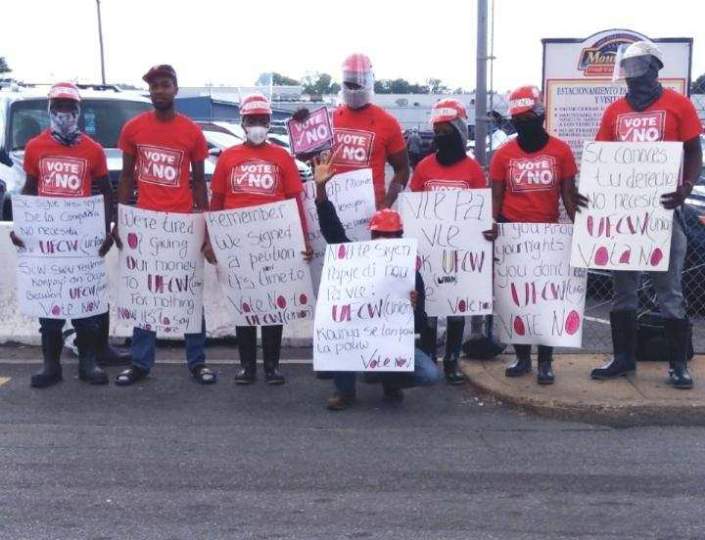 Employees at the Selbyville, DE, Mountaire Farms plant rally to vote out unpopular UFCW honchos from their workplace, as union lawyers scramble to block the workers’ votes from being counted.
WASHINGTON, DC – The National Labor Relations Board (NLRB) has announced that it will review the so-called “contract bar” doctrine, which prevents employees from exercising their right to vote an unpopular union out of their workplace for up to three years if union officials and their employer have finalized a monopoly bargaining contract.
This is the latest development in a case by a Selbyville, Delaware-based Mountaire Farms poultry employee, Oscar Cruz Sosa, against the United Food and Commercial Workers (UFCW) Local 27 union. Cruz Sosa submitted a petition in February for a vote on whether Local 27 should be removed as monopoly bargaining agent in his workplace. The petition was signed by hundreds of his coworkers, more than the percentage required to trigger such a vote.
Worker Obtains Foundation Help after Union Attempts to Block Vote
After he submitted the petition, UFCW bosses immediately claimed that the “contract bar” should block Cruz Sosa and his coworkers from even having an election, because the monopoly bargaining agreement between Mountaire and the union had been signed less than three years earlier.
Cruz Sosa then obtained free legal assistance from National Right to Work Foundation staff attorneys in defending his and his coworkers’ right to vote. With Foundation aid, he also hit UFCW agents with federal unfair labor practice charges for imposing an illegal forced-dues clause on the workplace and threatening him after he submitted the petition.
When the NLRB Regional Director in Baltimore heard the election case, he ruled that the union contract contains an unlawful forced-dues clause that mandates workers immediately pay union dues upon hiring or be fired. Under NLRB precedent, an illegal forced-dues clause means the “contract bar” cannot apply, allowing the vote to proceed.
UFCW’s Desperate Attempt to Block Vote Triggers NLRB Review of “Contract Bar”
Despite the longstanding precedent supporting the Regional Director’s ruling, UFCW union lawyers filed a Request for Review, asking the full NLRB to reverse the Regional Director and halt the election.
In response, Cruz Sosa’s Foundation staff attorneys opposed the union’s efforts to block the vote. They also argued that, if the Board were to grant the union’s Request for Review, it should also reconsider the entire “contract bar” policy, which has no statutory basis in the NLRA. The Foundation’s legal brief noted that the “contract bar” runs counter to the rights of workers under the NLRA, which explicitly include the right to vote out a union a majority of workers oppose.
Just hours after the voting process in the decertification election had begun, the NLRB issued its order granting the union’s Request for Review, while also accepting the Foundation’s request to reconsider the entire “contract bar” doctrine. The order noted “that it is appropriate for the Board to undertake in this case a general review of its ‘contract bar’ doctrine.”
Given the precedential import of this case, the NLRB solicited amicus briefs on whether the “contract bar” should be allowed to stand. UFCW officials, still desperate to throw a wrench in Cruz Sosa and his coworkers’ effort to vote them out, demanded that the NLRB rescind its request for amicus briefs in the case, but that effort was quickly rebuffed.
“We urge the NLRB to swiftly overturn this outrageous non-statutory policy, which lets union bosses undermine for up to three years the free choice of workers that is supposed to be at the center of federal labor law,” commented National Right to Work Foundation Vice President and Legal Director Raymond LaJeunesse. “The very premise of the NLRB-created ‘contract bar,’ that union bosses should be insulated from worker decertification efforts, is completely backwards.”
LaJeunesse added: “Union officials across the country use all types of tactics to get workers into unions but rely on government power and legal tricks to prevent them from getting out.”
Chicago Transit Worker Joins Mark Janus at Supreme Court in Demanding Refunds
The following article is from the National Right to Work Legal Defense Foundation’s bi-monthly Foundation Action Newsletter, September/October 2020 edition. To view other editions or to sign up for a free subscription, click here.
Workers from Ohio, Connecticut also primed to ask High Court to weigh in on issue

Chicago transit worker Benito Casanova is one of a growing number of workers who, with Foundation aid, are pursuing a Supreme Court ruling that will make union bosses return years of unconstitutional fees.
CHICAGO, IL – With free legal aid from National Right to Work Foundation staff attorneys, Chicago Transit Authority worker Benito Casanova has submitted a petition for writ of certiorari to the U.S. Supreme Court in his class-action lawsuit against the International Association of Machinists (IAM) Local 701 union.
Casanova’s case seeks a ruling that will make IAM officials return union fees that they forced Casanova and other workers to pay in violation of their First Amendment rights as recognized in the 2018 Foundation-won Janus v. AFSCME Supreme Court decision. In Janus, the Court ruled that no public sector worker can be forced to pay union dues or fees as a condition of employment, and that union fees can only be deducted from worker paychecks with their affirmative consent.
Janus lead plaintiff Mark Janus, a former Illinois child support specialist, is also awaiting the Supreme Court’s decision on whether to grant a writ of certiorari in the continuation of his case, which seeks a similar refund. Federal courts (including the Seventh Circuit Court of Appeals,
which ruled against both Janus and Casanova and prompted their petitions to the High Court) have so far allowed union officials to keep forced fees seized against workers’ First Amendment rights as recognized in the Janus decision.
The issue was always expected to end up at the High Court, especially with so many cases and so much money on the line. Foundation attorneys represent Casanova, Janus, and other public workers in about 20 cases, seeking the return of an estimated $130 million or more in unconstitutionally seized dues.
Foundation-Backed Petitions Defending Janus Rights Pile Up at High Court
In addition to Casanova’s case, two other class-action cases are now at the stage where Foundation staff attorneys can ask the Supreme Court to hear those cases, or, should the court agree to hear Janus or Casanova, to hold them pending a Supreme Court ruling.
One of the cases concerns Ohio Tax Department Employee Nathaniel Ogle, who seeks the return of millions in forced union fees taken by Ohio AFSCME union bosses from a large class of state employees. In the other case, Connecticut state environmental workers James Grillo and Kiernan Wholean seek the return of potentially millions of forced fees seized by Service Employees International Union (SEIU) bosses from another large class.
“In the 2018 Janus decision, the Supreme Court majority recognized that it is ‘hard to estimate how many billions of dollars have been taken from non-members and transferred to public sector unions in violation of the Constitution,” commented National Right to Work Foundation Vice President and Legal Director Raymond LaJeunesse. “Mr. Casanova and many other public workers throughout the country just want their illegally seized wages to be returned, so it is critical that the Supreme Court take up this issue.”
Oklahoma Sysco Employees Boot Unpopular Teamsters Bosses from Warehouse
The following article is from the National Right to Work Legal Defense Foundation’s bi-monthly Foundation Action Newsletter, September/October 2020 edition. To view other editions or to sign up for a free subscription, click here.
Union officials too afraid of results to hold a vote after majority of workers sign petition against union

Sysco employee Henry Weilmuenster and a majority of his colleagues backed two petitions which sought to eject unpopular Teamsters officials from their warehouse.
OKLAHOMA CITY, OK – With free legal aid from National Right to Work Foundation staff attorneys, Sysco Oklahoma warehouse employee Henry Weilmuenster and his coworkers have successfully removed an unwanted Teamsters union from their workplace.
Weilmuenster and his coworkers achieved their victory by taking advantage of the rights won by Foundation staff attorneys in the National Labor Relations Board’s (NLRB) 2019 Johnson Controls decision. In Johnson Controls, the NLRB ruled that an employer can withdraw recognition from a union if it receives a majority-backed employee petition opposing the
union within 90 days of a monopoly bargaining contract expiring. Union officials then have a 45-day window to contest such a withdrawal of recognition, but only by requesting a secret-ballot vote among the employees in the workplace on whether the union should stay.
In December 2019, Weilmuenster submitted both a petition to the NLRB for a secret-ballot vote to remove the union and a petition to Sysco asking that it withdraw recognition of the Teamsters union at the first available opportunity. Both requests were supported by a majority of his coworkers.
Though NLRB Region 14 officials in January blocked Weilmuenster and his coworkers’ request for a decertification vote in response to dubious “blocking charges” from Teamsters officials, Sysco ultimately withdrew recognition from the Teamsters union based on the showing of majority employee support for withdrawal in Weilmuenster’s petition. Under Johnson Controls, Teamsters honchos had a 45-day window to file for a secret-ballot election to reinstall the union, but did not do so — apparently because they feared an election loss. After that, the union was gone for good.
“This case demonstrates why Johnson Controls is so important,” commented National Right to Work Foundation Vice President Patrick Semmens. “Union bosses should not be allowed to maintain monopoly power over workers through legal maneuvering when there is clear evidence that a majority of workers want the union out of their workplace.”
Foundation Defends New Rules Protecting Right to Remove Unwanted Unions
The following article is from the National Right to Work Legal Defense Foundation’s bi-monthly Foundation Action Newsletter, September/October 2020 edition. To view other editions or to sign up for a free subscription, click here.
AFL-CIO kingpins suing to overturn NLRB rules slashing barriers to decertification votes

Over the past few years, the Foundation has provided free legal aid to workers
across the country who were blocked by pro-union boss NLRB rules from voting
out an unwanted union. Above are just a handful of them.
WASHINGTON, DC – The National Labor Relations Board’s (NLRB) new rules, designed to safeguard the right of workers to remove an unwanted union hierarchy in their workplace, went into effect on July 31. The policies, which were finalized in April, closely followed comments submitted by National Right to Work Foundation staff attorneys and petitions sent by thousands of Foundation supporters.
The policies specifically curtailed the non-statutory “blocking charge” and “voluntary recognition bar” policies used to trap workers in unions they oppose, and also eliminated a scheme used by union bosses in the construction industry to impose unionization without any evidence of worker support.
Less than a month before the reforms went into effect, union lawyers with the AFL-CIO filed a lawsuit against the NLRB in an attempt to reimpose these coercive restrictions on workers. Foundation attorneys are primed to defend the reforms and counter the wild claims AFL-CIO legal operatives make in the lawsuit.
New Rules Designed to Shield Workers from Unwanted Unions
The new rules are meant to eliminate virtually all union “blocking charges,” which are filed by union bosses to prevent rank-and-file employees from exercising their right to vote to remove a union.
Under the NLRB’s new policy, union charges cannot indefinitely stall the employees’ vote from taking place, and in most instances the vote will occur without delay. Additionally, as the Foundation advocated in comments, the NLRB modified its original proposed rule so that after employees vote, the ballots will be tallied and the vote announced in most cases instead of being impounded for months or even years while “blocking charges” are resolved.
The NLRB also reversed an Obama-era ruling imposing the so-called “voluntary recognition bar” policy. Under that policy, workers were blocked for up to a year from requesting a secret-ballot election to challenge a union which was installed as their monopoly bargaining agent through an abuse-prone “Card Check” drive, which bypasses the NLRB-supervised secret-ballot election process. In reversing the Obama NLRB, the current Labor Board reinstated a precedent won by Foundation staff attorneys for workers in the 2007 Dana Corp NLRB decision.
Under the Dana Corp. system, employees subject to “Card Check” drives and so-called “voluntary recognition” can promptly file for a secret-ballot election to contest the installation of a monopoly representative at their workplace.
Foundation Prepares to Counter Dubious Claims of AFL-CIO Suit Against NLRB
Unwilling to lose their power to block workers’ efforts to vote them out, the AFL-CIO filed suit against the rules even before they went into effect. The union boss lawsuit alleges, among other things, that the NLRB was misusing the rulemaking process by advancing these protections for independent-minded workers, even though union bosses widely cheered Obama NLRB efforts to use rulemaking to expand union boss power.
Foundation staff attorneys quickly began preparing to counter the AFL-CIO’s lawsuit aiming to reverse these reforms.
“Anyone who is familiar with the tactics of union bosses knows that they will fight tooth and nail to keep government-granted privileges in place that allow them to force their one-size-fits-all ‘representation’ on workers, even when a majority oppose their presence,” observed National Right to Work Foundation Vice President Patrick Semmens. “Foundation supporters should be proud that their advocacy helped obtain these new protections for workers opposed to unionization, but as the union boss lawsuit shows, the Foundation’s litigation program will continue to be critical to defending the rights of independent-minded workers.”
At Foundation’s Urging, NLRB Eliminates Barriers to Removing Unpopular Unions
The following article is from the National Right to Work Legal Defense Foundation’s bi-monthly Foundation Action Newsletter, July/August 2020 edition. To view other editions or to sign up for a free subscription, click here.
New rule curtails union boss tactics used to block employees’ right to vote out unions they oppose

The Foundation’s comments helped the NLRB scrap its policy allowing “blocking charges,” which IUOE bosses used to stymie Rieth-Riley worker Rayalan Kent and his coworkers’ right to vote them out.
WASHINGTON, DC – Following two rounds of comments from the National Right to Work Legal Defense Foundation and over 8,000 petitions from Right to Work supporters, the National Labor Relations Board (NLRB) has issued final rules substantially eliminating two pernicious tactics used by union bosses to stop workers from exercising their right to hold a vote to remove an unwanted union.
The NLRB’s new rules, finalized in April, dealt blows to the non-statutory “blocking charge” and “voluntary recognition bar” policies and to forced unionism schemes in the construction industry. All three reforms were encouraged by the Foundation’s initial January comments to the federal agency, which pressed the agency to get rid of all restrictions on decertification elections that are not mandated by the National Labor Relations Act (NLRA).
New Rule Knocks Down Three Rights Restrictions Targeted by Foundation
The new rule essentially eliminates union “blocking charges,” which union bosses file to prevent rank-and-file employees from exercising their right to vote to remove a union. Under the old rule, unions could block workers’ requested votes from taking place for months or even years by making one or multiple allegations against the employer, which were often unrelated to the employees’ decertification petition and frequently unsubstantiated.
Under the new rule, union charges cannot indefinitely stall the employees’ vote from taking place and in most instances the vote will occur without delay. Additionally, as the Foundation advocated, the NLRB modified its proposed rule so that after the employees vote, the ballots will be tallied and released in the vast majority of cases instead of being impounded and not counted.
This is a vast improvement on the NLRB’s original proposal to utilize a “vote and impound” system regarding employees’ decertification votes. Although such a system would have permitted employees to vote despite “blocking charges,” the results could have been withheld for months or years until the underlying “blocking charges” were resolved. Foundation staff attorneys argued against such a system in their January comments, pointing out that it would “frustrate and confuse employees who may have to wait years to see the election’s results,” while leaving the union in power the entire time.
The NLRB also substantially eliminated the so-called “voluntary recognition bar” policy. In the past, union officials had used this policy to block workers from requesting a secret-ballot election after the union had been installed as their monopoly bargaining agent through abuse-prone “Card Check” drives that bypass the NLRB-supervised secret-ballot election process. The Trump NLRB’s new rule reinstates a system secured by Foundation staff attorneys for workers in the 2007 Dana Corp. NLRB decision.
Under the Dana Corp. system, employees subject to “Card Check” drives and so-called “voluntary recognition” can promptly file for a secret-ballot election to contest the installation of a monopoly representative at their workplace. Despite thousands of workers using this process to secure secret-ballot votes after being unionized through “Card Checks,” the Obama NLRB overturned Dana in 2010 over the objections of Foundation staff attorneys in a case called Lamons Gasket.
Additionally, the NLRB made changes advocated by the Foundation’s January comments to crack down on schemes in the construction industry where employers and union bosses are allowed to unilaterally install a union in a workplace without first providing any proof of majority union support among the workers.
Foundation Fights to Enforce Workers’ Right to Remove Unwanted Unions
Foundation staff attorneys are currently providing free legal aid to several workers who are challenging union boss attempts to stymie their right to vote out an unwanted union, even in light of the new NLRB protections.
In Michigan, NLRB Region 7 officials stifled Rieth-Riley Construction Company employee Rayalan Kent’s decertification petition that he submitted for his coworkers. Region 7 officials told him that the election would be held up “pending the investigation” of charges filed by Operating Engineers (IUOE) union bosses against Rieth- Riley, but never explained to him why IUOE bosses’ allegations were significant enough to affect their right to vote.
Foundation staff attorneys in April submitted a request for review for Kent and his coworkers to the NLRB in Washington, D.C., asking that the Board immediately permit them to exercise their right to vote to remove the unpopular IUOE union.
“While this NLRB still has much more to do, the long-awaited new rules represent significant steps towards fully protecting the statutory right of employees under the NLRA to remove a union opposed by a majority of workers,” observed National Right to Work Foundation Vice President Patrick Semmens. “The ‘blocking charge’ policy that is finally being modified has always been particularly odious in its treatment of employee rights, for it allows union allegations against an employer to be grounds for blocking the statutory rights of employees who are not accused of any wrongdoing.”
“Foundation supporters, who deluged the NLRB with demands to safeguard the right of rank-and-file employees to vote, free of coercion, on whether or not union bosses are worthy to speak for them in the workplace, should be proud that their voices helped spur these important reforms,” Semmens added.





