
California Lifeguards Ask Supreme Court to Blow Whistle on Dues-Trap Scheme
The following article is from the National Right to Work Legal Defense Foundation’s bi-monthly Foundation Action Newsletter, November/December 2022 edition. To view other editions of Foundation Action or to sign up for a free subscription, click here.
Union bosses’ ‘maintenance of membership’ scheme drowns California lifeguards’ Janus rights for four years

These California lifeguards can ride the waves, but they certainly didn’t “waive” their Janus rights. In their Supreme Court bid, they hope to stop union bosses from locking them out of their First Amendment rights for years.
LOS ANGELES, CA – National Right to Work Foundation client Jennifer Marshall, an Orange County, CA, lifeguard, told the Los Angeles Times in May how hard California Statewide Law Enforcement Agency (CSLEA) union officials pushed union membership on her and her colleagues.
“They really pushed us to sign up for the union without a lot of information behind it,” said Marshall. “It was kind of a sign-the-papers-and-we’ll-talk-about-it-later kind of thing.” After she signed up, she hardly ever saw or heard from union officials again but full union dues were coming out of her paycheck.
What she and many of her colleagues, whom union bosses had cajoled into signing up, didn’t expect was how hard it would be to exit a union that didn’t seem to be doing anything for them. When she and her colleagues tried to resign, CSLEA officials told them that they were stuck in both full union dues payments and full union membership until 2023, pursuant to a so-called “maintenance of membership” requirement.
Marshall, along with lead plaintiff Jonathan Savas and 21 other colleagues, sued CSLEA bosses in federal court in 2020 for violating their constitutional rights. They argued the “maintenance of membership” requirement blatantly infringes on their First Amendment rights under the Foundation-won Janus v. AFSCME Supreme Court decision. In Janus, the Court declared that public sector workers cannot be forced to bankroll a union without voluntarily waiving their First Amendment right to abstain from union payments. The lifeguards also sued the state of California for its role in enforcing the unconstitutional dues deductions.
Secret Union Dues Scheme Has Been Illegal for 45 Years
Marshall, Savas, and their fellow lifeguards are now petitioning the Supreme Court of the United States to hear their case, arguing CSLEA bosses’ restrictive arrangement even violates Supreme Court precedent that predates Janus.
The lifeguards’ Foundation provided attorneys argue in the petition that “maintenance of membership” requirements not only flout Janus’ ban on all forced dues in the public sector, but even violate the Supreme Court’s now-overturned 1977 decision in Abood v. Detroit Board of Education. Abood let union officials force dissenting public sector employees to pay a portion of union dues as a condition of employment.
“Maintenance of membership” requirements – which force public employees to pay full union dues often for years after they try to resign from the union – are worse than anything permitted by Abood, Foundation staff attorneys argue.
The petition also takes to task CSLEA union bosses’ paltry defense that the lifeguards somehow voluntarily agreed to the “maintenance of membership” scheme. In Janus, the Supreme Court ruled that union officials can only take dues from a public employee’s paycheck if that employee gives a “clear and compelling” waiver of Janus rights. Foundation attorneys point out that the CSLEA union’s dues deduction forms contained only a “vague reference” to an unexplained limit on when withdrawal from membership is permitted, which is not even close to satisfying Janus’ waiver requirement.
“A vague reference to unspecified limitations in ‘the Unit 7 contract and State law’ does not establish the Lifeguards contractually consented” to union membership for four years, the petition says.
Supreme Court Must Intervene to Stop Spread of Unconstitutional Restrictions
The petition for Savas and his fellow lifeguards emphasizes how crucial it is for the Supreme Court to strike down cumbersome “maintenance of membership” restrictions, pointing out that California unions and legislators will continue to force public employees to remain formal union members and pay full dues as a condition of employment if the schemes are left unchecked.
“Other states likely will follow suit, such as Pennsylvania, whose laws also authorize maintenance of membership requirements,” the brief states.
Challenged Scheme Gives Union Bosses Control of Workers’ Janus Rights
“‘Maintenance of membership’ restrictions give union officials complete control over when public employees can exercise their rights to end union membership and cut off union dues deductions,” observed National Right to Work Foundation Vice President and Legal Director Raymond LaJeunesse.
“The Supreme Court must intervene in these lifeguards’ case to protect the First Amendment rights of all American public sector employees, and prevent union bosses and their political allies from replicating across the country these patently unconstitutional restrictions.
Pittsburgh-Area Teen Hits UFCW Union and Giant Eagle with Religious Discrimination and Unfair Labor Practice Charges
Union sought to interrogate teenage cashier over his religious beliefs after he asserted his rights and presented religious objections to supporting the union
Pittsburgh, PA (January 17, 2023) – North Huntingdon Giant Eagle employee Josiah Leonatti – a high school student – has filed federal discrimination charges against the United Food and Commercial Workers (UFCW) Local 1776KS union. He maintains that union officials refused to consider his religious beliefs after he expressed religious objections to joining and paying dues to the union. Union officials, according to his charges, subjected him to an illegal “religion test” to determine whether his religious beliefs count.
Leonatti is receiving free legal aid from National Right to Work Legal Defense Foundation staff attorneys, who filed charges for him against the union at both the Equal Employment Opportunity Commission (EEOC) and the National Labor Relations Board (NLRB). They also filed charges against Giant Eagle for firing him after he asked for a religious accommodation. Giant Eagle falsely told him that he must join the union to keep his job.
Leonatti charges that the UFCW union and Giant Eagle are breaching Title VII of the Civil Rights Act of 1964, as well as the National Labor Relations Act (NLRA). Title VII requires unions and employers to accommodate employees who have religious objections to joining or supporting a union. The NLRA also prohibits forced union membership regardless of a worker’s reason for not wanting to affiliate with a union. Leonatti’s Title VII claims will be investigated by the EEOC; the NLRB will handle his NLRA claims.
Pennsylvania’s lack of Right to Work protections means that union officials may force private sector workers in unionized workplaces, like Leonatti, to pay them fees or be fired. Under federal law, employees with religious objections cannot be compelled to pay such fees. Right to Work states broaden that protection; in Right to Work states, no worker can be fired for refusal to join or financially support a union no matter the reason for objecting to subsidizing union activities.
High School-Age Employee Dismissed After Presenting Religious Objection
Leonatti’s charges report that he attended employee training last year as a cashier trainee. There an official told new hires that they “must sign papers to join the United Food And Commercial Workers.” According to the NLRB charges, “No other options were even hinted at.”
After reviewing the papers with his family, Leonatti’s charges explain, he mailed a letter to UFCW officials detailing his sincere religious objections to joining and supporting the union. He also presented the same letter in person at training. Rather than accommodate his sincere religious beliefs, a company official “dismissed [Leonatti] from training and sent [him] home.” The same official later called Leonatti and told him that union membership is compulsory at Giant Eagle, and the grocery store had terminated him over his refusal to join.
UFCW officials also responded to Leonatti’s letter by mail on November 10, rejecting the written explanation of Leonatti’s religious objection and demanding he “complete its religious examination” before they even considered granting him an accommodation. Even if he passed this “test,” the charges say, union officials threatened that he would still have to pay an amount equal to full UFCW union dues to a charity.
A religious test is forbidden by federal law. The Supreme Court ruled in its 1981 Thomas v. Review Board of the Indiana Employment Security Division decision that “religious beliefs need not be…comprehensible to others in order to merit First Amendment protection.”
Leonatti’s father called Giant Eagle’s HR department, according to the charges, to gain more clarity. A Giant Eagle employee reiterated that employment depended on union membership. After missing several weeks of work because the store had terminated him, Leonatti got an email from Giant Eagle inviting him to return to work.
To date, however, no Giant Eagle agent ever offered or discussed a religious accommodation with Leonatti, and the union has not retracted its threats or agreed to accommodate.
Employee Seeks Re-Training for Accommodation-Denying Union Officials
Leonatti’s EEOC charges seek to compel the UFCW union and Giant Eagle to provide him a legally-required religious accommodation. In addition, the NLRB charges state that relief must include unit-wide information and corporate retraining, among other remedies.
“Union bosses’ attempt to coerce a high schooler to violate his religious beliefs is unconscionable, and illegal,” commented National Right to Work Foundation President Mark Mix. “We’re proud to support Mr. Leonatti as he defends his rights, but this should serve as a stark reminder that all Americans deserve Right to Work protections. Regardless of their particular reasons for not wanting to affiliate with a union, no employee’s job should hinge on whether he or she pays dues to a private organization.”
Worker Advocate Files Supreme Court Brief Opposing Union Boss Attempt to Evade Liability for Property Damage
Amicus brief in Glacier Northwest argues “Unions need no further exemptions and special legal privileges” and SCOTUS should “scrutinize” existing ones
Washington, DC (November 7, 2022) – The National Right to Work Legal Defense Foundation today filed an amicus brief at the United States Supreme Court. The brief argues that the High Court should overturn a Washington Supreme Court decision that created a special exemption for union officials and their “more aggressive” members from liability under state tort law when property destruction and vandalism result from union boss-ordered actions.
The Foundation’s brief was filed in Glacier Northwest Inc. v. International Brotherhood of Teamsters Local 174, which deals with a union boss-ordered strike against construction company Glacier Northwest. Glacier Northwest’s attempt to sue the union over property damage caused by strike activities was denied by the Washington Supreme Court. Washington’s highest court accepted Teamsters lawyers’ argument that the National Labor Relations Act’s (NLRA) allowance for union strikes somehow also immunizes unions from liability when strike activities destroy and vandalize property.
The Supreme Court announced last month it would hear arguments in the case. Those arguments haven’t been scheduled yet but are expected to occur in early 2023.
The Foundation provides free legal aid to hundreds of workers every year whose rights have been violated by compulsory unionism abuses, including those that occur during strikes. It contends in the brief that the Washington Supreme Court’s creation of a new “carve-out” in state law for vandalism and property destruction organized by union officials will leave not only employers, but also employees, with no recourse when harmed by such strike violence and mayhem. The Foundation points out that union officials already enjoy a slew of privileges and immunities under state and federal law enjoyed by no other private organization or citizen, and that this power should be pared back instead of expanded.
Foundation: Union Officials’ Enormous Special Legal Privileges Should Not Be Expanded
The Foundation explains in the amicus brief that “states’ interest in protecting life, limb, and private property must be respected under principles of federalism” because federal remedies generally don’t exist for violations of these interests. Far from being a concern only for employers who face union strike efforts, the Foundation argues, employees are often targeted by hostile or violent strike behavior and state courts often are the only forum in which they can receive justice.
“For example, in Clegg v. Powers, employees sought damages in state court for union violence and property damage during a strike,” the brief says. “Cases like Clegg demonstrate that the Court should limit” unions’ ability to dodge liability in state courts, not extend it, says the brief.
The Foundation’s brief then points out that the exemption from liability for torts that Teamsters bosses seek should also be restricted given “the extraordinary privileges and exemptions already granted to unions” by Congress and courts all over the country.
These include, but are not limited to, the ability to perform acts that would be considered extortion if committed by any other private party, pursuant to the controversial 1973 United States v. Enmons Supreme Court decision. Union officials also have the privilege to foist monopoly “representation” over all workers in a workplace regardless of whether they are union members or voted for the union in power. Probably the most abusive union boss privilege of all is the power to force employees in non-Right to Work states to pay union dues or fees just to stay employed, while maintaining monopoly bargaining control in a workplace with no effective term limits.
“This Court should treat unions like all other citizens or entities, clarifying that they can be liable for damages in state courts under ‘the common law rule that a man is held to intend the foreseeable consequences of his conduct,’” the brief concludes.
“Union officials’ theory that they should be off the hook in state court for damaging or vandalizing property is outrageous on its face. The law already has plenty of carve-outs and privileges for union hierarchies that no other private organization or citizen gets to enjoy – least of all the workers union bosses claim to ‘represent,’” commented National Right to Work Foundation President Mark Mix. “Union officials regularly force millions of workers to pay union fees or be fired, and force their ‘representation’ on millions of workers who bitterly oppose it. The Supreme Court must reject this shocking union ploy for even more coercive powers, and hold the existing set of union boss privileges to much more scrutiny.”
National Right to Work Foundation Slams Biden National Labor Relations Board’s Move to Reverse ‘Election Protection Rule’
Union boss-beholden NLRB to make it easier for union bosses to block workers from exercising right to vote out unpopular unions
Washington, DC (November 3, 2022) – The National Labor Relations Board (NLRB) today announced it was initiating rulemaking to rescind the Board’s Election Protection Rule, a 2020 provision that, among other things, helped protect rank-and-file workers’ statutory right to hold votes to remove unwanted union officials.
National Right to Work Foundation President Mark Mix issued the following statement on the Biden NLRB’s announcement:
“The Biden-appointed NLRB majority – two of whom were union lawyers when nominated for their seats on the Board – is once again protecting union boss power to the detriment of the statutory rights of rank-and-file workers. Make no mistake, reversing the Election Protection Rule will mean more workers trapped in forced union ranks they oppose, and more denials of worker requests for basic secret-ballot votes regarding union status.
“The NLRB’s own statistics indicate that workers are currently seeking to throw out unwanted unions at the highest rate in years. Yet, rather than reflect on why so many workers want nothing to do with union so-called ‘representation,’ the anti-worker response of the Biden Administration and their Big Labor allies is to build a wall to keep workers in unions, or to stop them from even holding votes to oust incumbent union bosses.”
NLRB Seeks to Undermine Right to Vote as Worker Decertification Efforts Increase
The NLRB adopted the Election Protection Rule in 2020 after multiple rounds of comments from Foundation staff attorneys supporting the changes. The rule included reforms to the NLRB process for dealing with union “blocking charges,” which union bosses often file to prevent rank-and-file employees from exercising their right to vote out a union. Union officials manipulate “blocking charges” to stop workers’ requested votes from taking place for months or even years by making one or multiple allegations against the employer.
The 2020 rule stopped union charges from stalling worker-requested votes, and in most cases permitted the immediate release of the vote tally as opposed to ordering ballots to be impounded during litigation over “blocking charges.”
The Election Protection Rule also substantially eliminated the so-called “voluntary recognition bar,” a policy that union officials exploited to block workers from requesting a secret-ballot election after a union is installed through the abuse-prone “card check” process. The NLRB instead adopted a Foundation-backed process in which workers could submit a petition to hold a secret-ballot vote after a union’s installation by “card check,” with the secret-ballot election determining whether the union actually had the majority support union officials claimed in their submission of “union cards.”
Additionally, the Election Protection Rule cracked down on schemes in the construction industry where employers and union bosses installed a union in a workplace without first providing proof of majority union support among the workers. Foundation staff attorneys represented a victim of such a scheme in a case (Colorado Fire Sprinkler, Inc.) that ended when a DC Circuit Court of Appeals panel unanimously ruled for the worker, who had been unionized despite no evidence of majority employee support for the union. As the federal court said, “the rule is that employees pick the union; the union does not pick the employees.”
With the elimination of the Election Protection Rule, workers will not only have a much harder path toward getting a vote on whether a union should be ousted, but even if the vote is held, they will likely be kept in the dark about the results of that vote for months or even years if litigation follows union “blocking charges.” Also, workers forced into union ranks via “card check” would be barred for potentially years from ever holding a secret-ballot vote to determine the level of union support, as the bar following “card check” is often combined with other non-statutory bars like the three-year “contract bar.”
Workers nationwide relied on the Election Protection Rule as they exercised their right to vote out unpopular unions, and the NLRB’s own statistics show a sharp increase in worker decertification efforts. In 2021, the year following the Election Protection Rule’s adoption, Foundation attorneys aided over 7,000 workers at 54 workplaces in exercising their right to hold votes to boot unwanted union officials.
Flight Attendant Asks for Contempt Ruling Against Southwest for Violating Court Order Regarding Illegal Firing at Union’s Behest
District Court ordered Southwest to announce that airline may not discriminate on basis of religion; airline instead effectively denied wrongdoing despite jury verdict
Dallas, TX (January 9, 2023) – With free legal aid from National Right to Work Foundation attorneys, Southwest Airlines flight attendant Charlene Carter is seeking sanctions against Southwest for flouting the U.S. District Court for the Northern District of Texas’ decision in her case. Carter sued both Transport Workers Union (TWU) Local 556 and Southwest in 2017 for firing her over opposing the union’s political stances – a violation of both the Railway Labor Act and Title VII of the Civil Rights Act.
The District Court in December 2022 ordered Southwest and the union to give Carter the maximum amount of compensatory and punitive damages permitted under federal law, plus back-pay, and other forms of relief that a jury originally awarded following Carter’s victory in a July trial. The Court also mandated that Southwest reinstate Carter, ruling that only requiring Southwest and the TWU union to pay out future monetary damages to Carter “would complete Southwest’s unlawful scheme” of firing dissenting employees.
Carter’s latest motion calls on the District Court to impose sanctions against Southwest for releasing a misleading “Recent Court Decision” notice to its roughly 17,000 flight attendants, arguing that the notice papers over the airline’s significant rights violations found by the Court. The notice states that Southwest “does not discriminate” against its employees based on religious belief, despite the Court’s finding that Southwest did discriminate against Carter on religious grounds. The motion also says Southwest’s notice fails to make a court-ordered announcement that the airline is forbidden from discriminating in the future.
Foundation attorneys also contend that an “Inflight Information On The Go” memo the airline issued chills flight attendants’ religious expression, beliefs, and practices. The memo implies that Southwest will be the final arbiter of what kind of religious speech is acceptable in the workplace, while characterizing Carter’s speech challenging the TWU union’s political positions as “inappropriate, harassing, and offensive,” and thus worthy of punishment.
The motion asks the District Court to find the airline in contempt so it can issue monetary sanctions against Southwest, and further order the airline to immediately issue corrective notices.
Flight Attendant Called Out Union Officials for Their Political Activities
As a Southwest employee, Carter joined TWU Local 556 in September 1996. A pro-life Christian, she resigned her membership in September 2013 after learning that her union dues were being used to promote causes that violate her conscience and have nothing to do with her work.
Carter resigned from union membership, but was still forced to pay fees to TWU Local 556 as a condition of her employment. State Right to Work laws do not protect her and her fellow flight attendants from forced union fees because airline and railway employees are covered by the federal Railway Labor Act (RLA). The RLA allows union officials to have a worker fired for refusing to pay union dues or fees. But it does protect the rights of nonmembers of the union who are forced to associate with a union, including the rights to criticize the union and its leadership, and advocate for changing the union’s current leadership.
In January 2017, Carter learned that Audrey Stone, the union president, and other TWU Local 556 officials used union money to attend the “Women’s March on Washington D.C.,” which was sponsored by political groups she opposed, including Planned Parenthood.
Carter, a vocal critic of Stone and the union, took to social media to challenge Stone’s leadership and to express support for a recall effort that would remove Stone from power. Carter also sent Stone a message affirming her commitment to both the recall effort and a National Right to Work law after the union had sent an email to employees telling them to oppose Right to Work.
After Carter sent Stone that email, Southwest managers notified Carter that they needed to have a mandatory meeting as soon as possible about “Facebook posts they had seen.” During this meeting, Southwest presented Carter screenshots of her pro-life posts and messages and questioned why she made them.
Carter explained her religious beliefs and opposition to the union’s political activities. Carter said that, by participating in the Women’s March, President Stone and TWU Local 556 members purported to represent all Southwest flight attendants. Southwest authorities told Carter that President Stone claimed to be harassed by Carter’s messages. A week after this meeting, Southwest fired Carter.
Flight Attendant Wins Jury Verdict and District Court Decision
In 2017, Carter filed her federal lawsuit with help from Foundation staff attorneys to challenge the firing as an abuse of her rights, alleging she lost her job because of her religious beliefs, standing up to TWU Local 556 officials, and criticizing the union’s political activities and how it spent employees’ dues and fees. In July 2022, she won a federal jury verdict awarding millions of dollars in damages for Southwest’s and TWU’s violations of her rights, and in December 2022 the District Court issued its judgment in her favor.
“First, Southwest Airlines violated Charlene Carter’s rights by firing her at the union’s behest. Now, the airline is doubling down by misleading other workers about its wrongdoing in defiance of a federal court order,” commented National Right to Work Foundation President Mark Mix. “Foundation attorneys will continue to defend Ms. Carter’s rights, and will ensure that Southwest’s attempts to dodge the requirements of the decision in her favor will not go unopposed.”
NYC University Professors Take Aim at Forced Union ‘Representation’
The following article is from the National Right to Work Legal Defense Foundation’s bi-monthly Foundation Action Newsletter, March/April 2022 edition. To view other editions of Foundation Action or to sign up for a free subscription, click here.
CUNY professors’ lawsuit argues NY law forces them under power of anti-Semitic union

Prof. Avraham Goldstein recalled in a Wall Street Journal piece the anti-Semitism his family faced in the Soviet Union. He and other plaintiffs argue they shouldn’t be forced to associate with a union that subjects them to similar hostility.
NEW YORK, NY – For decades, government sector union bosses have relied on two pillars of coercion — forced dues and forced representation — to maintain their grip on power over America’s public servants and the public services citizens rely on.
While the Supreme Court in the 2018 National Right to Work Foundation-won Janus v. AFSCME Supreme Court case recognized that forcing government employees to pay dues to stay employed violates the First Amendment, a new Foundation-assisted civil rights lawsuit from six City University of New York (CUNY) system professors may finally defeat union bosses’ privilege to impose union representation over the objections of public workers.
CUNY professors Jeffrey Lax, Michael Goldstein, Avraham Goldstein, Frimette Kass-Shraibman, Mitchell Langbert, and Maria Pagano sued the AFL-CIO-affiliated Professional Staff Congress (PSC) union, CUNY executives, and New York State officials in January, challenging New York State’s “Taylor Law” that gives unions monopoly bargaining privileges in public sector workplaces like CUNY.
The plaintiffs, most of whom are Jewish, oppose the union’s “representation” on the grounds that union officials and adherents have relentlessly denigrated their religious and cultural identity. Several of the plaintiffs exercised their Janus right to cut off dues after PSC officials rammed through a resolution in June 2021 that they found “anti-Semitic, anti-Jewish, and anti-Israel,” according to the lawsuit.
Discrimination Cited in Groundbreaking First Amendment Case
The lawsuit, which was filed with legal aid from both the National Right to Work Foundation and Pennsylvania-based Fairness Center, says: “Despite Plaintiffs’ resignations from membership in PSC, Defendants . . . acting in concert and under color of state law, force all Plaintiffs to continue to utilize PSC as their exclusive bargaining representative.”
The resolution is not nearly the worst example of PSC officials’ anti-Semitism, according to the lawsuit. Prof. Michael Goldstein asserts that adherents of PSC are waging a campaign to get him fired and have targeted him with harassment and threats such that he must have an armed guard accompany him on campus. Prof. Lax cites in the lawsuit a determination he has already received from the Equal Employment Opportunity Commission (EEOC) that “PSC leaders discriminated against him, retaliated against him, and subjected him to a hostile work environment on the basis of religion.”
While all of the professors take issue with PSC bosses’ radicalism, they also want to break free from internal conflicts within the large and disparate unit, which consists of full-time, part-time, and adjunct teaching employees and others. Prof. Kass-Shraibman states in the lawsuit that “instead of prioritizing the pay of full-time faculty, PSC expended resources advocating on behalf of teachers in Peru, graduate students at various other universities and the so-called ‘Occupy Wall Street’ movement.”
On top of all that, Profs. Avraham Goldstein, Kass-Shraibman, and Langbert contend that PSC officials aren’t even respecting their First Amendment Janus rights. Although all three professors clearly indicated they wanted to cut off financial support to the union, the lawsuit explains that “Defendants PSC and the City . . . have taken and continue to take and/or have accepted and continue to accept union dues from [their] wages as a condition of employment . . .” in violation of Janus.
“I had paid thousands of dollars in union dues for workplace representation, not for political statements or attacks on my beliefs and identity,” Prof. Avraham Goldstein wrote in a piece for The Wall Street Journal. “I decided to resign my union membership and naively thought I could leave the union and its politics behind for good.”
“I was wrong,” recounted Prof. Goldstein. “Union officials refused my resignation and continued taking union dues out of my paycheck.”
Suit Seeks Damages and to Overturn NY Law Authorizing Union Control
The lawsuit seeks a declaration from the U.S. District Court for the Southern District of New York that the Taylor Law’s imposition of monopoly union control is unconstitutional, and that the defendants cease “certifying or recognizing PSC, or any other union, as Plaintiffs’ exclusive representative without their consent.” The lawsuit also demands the union and university return dues seized in violation of Janus to Profs. Avraham Goldstein, Kass-Shraibman, and Langbert.
“By forcing these professors into a monopoly union collective against their will, the state of New York mandates that they associate with union officials and other union members who take positions that are deeply offensive to these professors’ most fundamental beliefs,” observed National Right to Work Foundation President Mark Mix. “New York State’s Taylor Law authorizes such unconscionable compulsion. It is time federal courts fully protect the rights of government employees to exercise their freedom to disassociate from an unwanted union, whether their objections are religious, cultural, financial, or otherwise.”
IAM Union ‘Becks’ Down in Boeing Technician’s Case Over Unlawful Dues Deductions
The following article is from the National Right to Work Legal Defense Foundation’s bi-monthly Foundation Action Newsletter, September/October 2022 edition. To view other editions of Foundation Action or to sign up for a free subscription, click here.
IAM bosses charged arbitrary higher amount in violation of Foundation-won Beck precedent

IAM union bosses’ illegal fee scheme faced headwinds when Boeing technician Don Zueger defended his rights with Foundation legal aid – and won.
SEATTLE, WA – Boeing technician Don Zueger didn’t want to sacrifice a cent from his paycheck to subsidize the activities of International Association of Machinists (IAM) union bosses who currently maintain monopoly bargaining power in his workplace. But, because he works in non-Right to Work Washington State, he can be forced to pay some union fees just to keep his job.
When Zueger found out union officials were calculating his forced fees amount based on financial data from nine other IAM affiliates – not just data from his own district union – he knew something was amiss.
Zueger sought free legal representation from the National Right to Work Legal Defense Foundation and filed a federal lawsuit against the IAM union for violating his rights under the 1988 Foundation-won CWA v. Beck U.S. Supreme Court decision. In Beck, the Court ruled that union officials cannot charge full union dues to objecting private sector workers who have abstained from formal union membership, and can only charge them “fees” which exclude expenses for things like union political activities.
IAM Bosses Use Baseless ‘Formula’ to Seize Excessive Forced Union Fees
Zueger’s lawsuit pointed out that IAM officials’ puzzling scheme imposed a dues amount on him that exceeds the limit that Beck established. Now he has won a settlement that requires union officials to decrease his dues payments and return money illegally taken from his wages.
Washington State’s lack of Right to Work protections mean that union officials can legally demand Zueger pay the reduced Beck amount as a condition of staying employed. In Right to Work states, in contrast, union membership and all union financial support are strictly voluntary.
According to Zueger’s lawsuit, filed in the U.S. District Court for the Western District of Washington, he submitted a request to IAM union officials in February resigning his union membership and asking for his dues payments to be reduced as Beck requires.
Zueger’s lawsuit noted that IAM officials’ response to his Beck request claimed that, under IAM’s nationwide policy, the portion of union dues he must pay is based on averages of selected audits that in each case include nine other district IAM affiliates and nine other locals. Unsurprisingly, this policy resulted in IAM officials claiming Zueger is required to pay a greater sum than what would be required if union officials only used the audits for the district and local unions Zueger is forced to fund.
His lawsuit sought to force IAM union bosses to return all money demanded in violation of Beck and to properly reduce his future union payments in accordance with Beck.
Rather than attempt to defend their scheme to increase Zueger’s forced fee amount, IAM union chiefs quickly backed down and settled the case.
IAM union officials have now, as the settlement mandates, returned to Zueger the difference between the proper Beck dues amount and the illegal amount the union imposed on him. IAM bosses are also forbidden from demanding any money above the correctly calculated reduced Beck portion in the future, making the settlement a full vindication of Zueger’s Beck rights.
IAM Must Return Dues That Could Have Gone to Union Boss Political Agenda
Zueger’s settlement comes after union bosses spent near-record sums on politics during the 2020 election cycle, and as Foundation attorneys deal with a flurry of worker requests concerning illegal forced dues for politics. According to a report by the National Institute for Labor Relations Research (NILRR) released in 2021, public data on union expenses shows about $2 billion in political spending during the 2020 election cycle. Other estimates suggest the actual union spending on political and lobbying activities topped $12 billion during this cycle.
“It’s shameful that union officials continue to invent new ways to violate the decades-old Beck Supreme Court precedent and overcharge workers who clearly want nothing to do with union bosses and their agenda – a big concern as union politicking heats up in advance of midterm elections,” commented National Right to Work Foundation Vice President Patrick Semmens. “This scheme to artificially manipulate forced dues calculations is part of the IAM’s nationwide policy, and the Foundation stands ready to assist other workers around the country who are being subjected to this anti-Beck IAM scheme.”
Full Foundation Action September/October 2022 Newsletter Now Online

All articles from the September/October issue of Foundation Action are now on the website.
In this issue:
- Foundation Client Wins $5.1 Million Verdict After Union Boss-Instigated Firing
- ATU Union Facing Prosecution After Agent Physically Assaults Bus Driver
- Foundation Helps Healthcare Workers Remove Unwanted Unions
- Foundation in the News: Exposing the Injustices of Forced Unionism
- IAM Union ‘Becks’ Down in Boeing Technician’s Case Over Unlawful Dues Deductions
- Kentucky Worker Hits Steelworkers Union with Complaint for Violation of Right to Work Law
Recent articles can be found here. To sign up for a free copy of the newsletter via mail please see the form at the bottom of this page.
Full Foundation Action July/August 2022 Newsletter Now Online
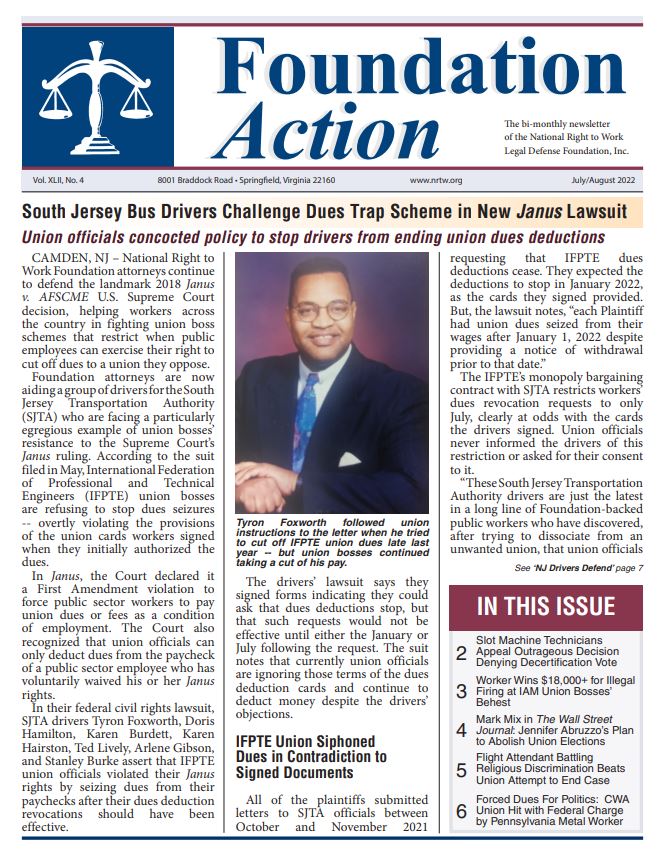
All articles from the July/August issue of Foundation Action are now on the website.
In this issue:
- South Jersey Bus Drivers Challenge Dues Trap Scheme in New Janus Lawsuit
- Slot Machine Technicians Appeal Outrageous Decision Denying Decertification Vote
- Worker Wins $18,000+ for Illegal Firing at IAM Union Bosses’ Behest
- Mark Mix in The Wall Street Journal: Jennifer Abruzzo’s Plan to Abolish Union Elections
- Flight Attendant Battling Religious Discrimination Beats Union Attempt to End Case
- Forced Dues For Politics: CWA Union Hit with Federal Charge by Pennsylvania Metal Worker
Recent articles can be found here. To sign up for a free copy of the newsletter via mail please see the form at the bottom of this page.
Full Foundation Action May/June 2022 Newsletter Now Online

All articles from the May/June issue of Foundation Action are available on the website.
In this issue:
- Courageous Tennessean Wins Big in Union Discrimination Suit
- Union Bosses Caught Red-Handed Illegally Taking Dues from Charter School Teacher
- Teamsters Officials ‘Beck’ Down: Must Return Thousands in Dues Seized for Politics
- Indiana US Brick Employees Target ‘Successor Bar’ for Demolition
- Atlantic Aviation Employees Win Freedom from Unwanted Union
- General Motors Worker Forces UAW Bosses to Stop Seizing Dues for Politics
Recent articles can be found here. To sign up for a free copy of the newsletter via mail please see the form at the bottom of this page.





