
KIPP St. Louis Charter High School Educators to Vote This Week on Whether to Oust AFT Union Bosses
Union decertification election will take place among wide swath of school employees, including teachers, advisors, administrative staff, and others
St. Louis, MO (May 14, 2024) – Teachers, advisors, nurses, and other employees at KIPP St. Louis High School will vote this week on whether to remove American Federation of Teachers (AFT) union officials from power at the school. The union decertification vote follows KIPP teacher Robin Johnston’s submission of a “decertification petition” earlier this month to National Labor Relations Board (NLRB) Region 14 in St. Louis. Johnston filed the decertification petition with free legal aid from the National Right to Work Foundation.
The NLRB is the federal agency responsible for enforcing federal labor law, which includes administering elections to install (or “certify”) and remove (or “decertify”) unions. Johnston’s petition contains signatures from enough of her coworkers to trigger a decertification vote under NLRB rules.
Because Missouri lacks Right to Work protections for its private sector workers (which includes employees at public charter schools like KIPP), union officials have the legal privilege to enforce contracts that force workers to pay union dues or fees as a condition of getting or keeping a job. In contrast, in Right to Work states, union membership and union financial support are strictly voluntary.
However, in both Right to Work and non-Right to Work states, union officials in a unionized workplace are empowered by federal law to impose a union contract on all employees in the work unit, including those who oppose the union. A successful decertification vote strips union officials of both their forced-dues and monopoly bargaining powers.
Vote Set to Take Place May 17
“AFT union officials haven’t stood up for us,” commented Johnston. “I think the majority of my coworkers agree that they’ve only made it harder for us to help our students succeed, especially through a divisive strike order, and that’s a trend I hope we can reverse with this vote. We hope the election proceeds without delay and without interference from union officials.”
The NLRB has scheduled a vote to occur on Friday, May 17. According to Johnston’s petition, the vote will occur among “College and Career Advisors, English Language Learners, Leads, Lead Teachers, Learning Support Teachers, Mental health Professionals, School Nurses, Special Ed. Teachers, Specials Teachers, Speech Language Pathologists, Virtual Learning Facilitators, Behavior Support Specialists, High School Registrars, Long Term Subs, Office Coordinators, Paraprofessionals, Permanent Building Subs and Receptionists” at the school.
Foundation attorneys have recently aided other charter school educators in efforts to remove unwanted union officials, most recently in San Diego, CA, where employees of Gompers Preparatory Academy prevailed in 2023 after a nearly four-year effort to vote out the San Diego Education Association (SDEA) union, an affiliate of the National Education Association (NEA).
“Top teacher union officials, including Randi Weingarten of the AFT and Becky Pringle of the NEA, seem to regularly make headlines for political radicalism and not for anything related to helping teachers, which seems to be a reality on the ground at KIPP St. Louis,” commented National Right to Work Foundation President Mark Mix. “Ms. Johnston and her fellow educators join a growing number of workers across the country who are realizing that union boss agendas don’t align with what’s best for them, and Foundation attorneys are proud to help them exercise their right to vote away unwanted union control.”
Foundation-Aided Employees Tell Congress: All Workers Need Right to Work
The following article is from the National Right to Work Legal Defense Foundation’s bi-monthly Foundation Action Newsletter, March/April 2024 edition. To view other editions of Foundation Action or to sign up for a free subscription, click here.
Workers’ real-life battles against union bosses emphasize need to end forced union dues
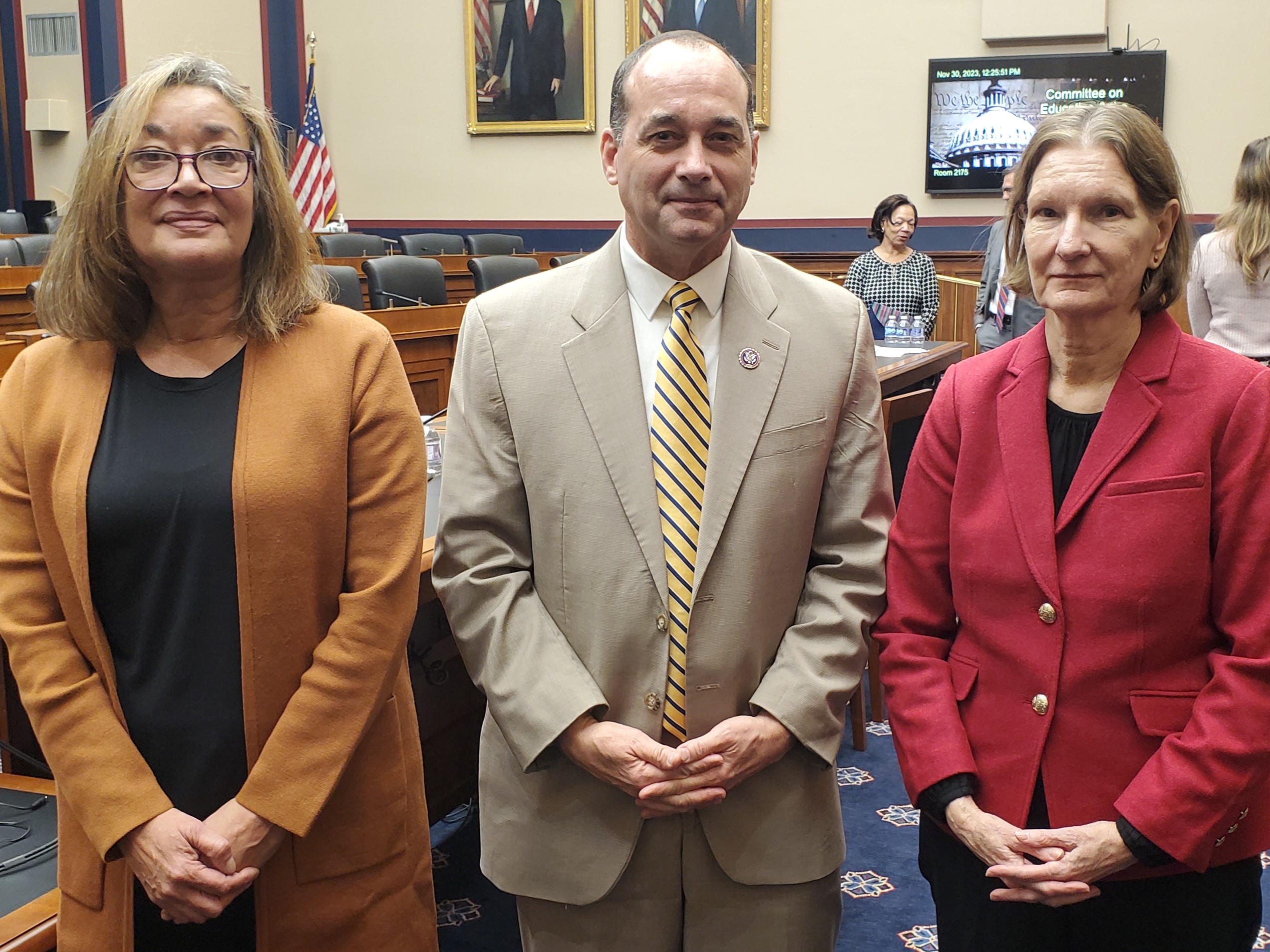
Foundation clients Brunilda Vargas (left) and Jeanette Geary (right) testified to Rep. Bob Good (center) and other members of the House Education and Workforce Committee about the danger forced dues still pose to America’s workers.
WASHINGTON, DC – In November, two recipients of National Right to Work Foundation free legal representation went to Capitol Hill to testify before the U.S. House Committee on Education and the Workforce about their battles against union bosses.
This was the first-ever congressional hearing on the National Right to Work Act, legislation that will safeguard American private sector workers’ freedom to refrain from paying dues to an unwanted union.
Jeanette Geary, a retired nurse, and Brunilda Vargas, a Philadelphia-based public defender, both successfully challenged illegal forced-dues demands with Foundation aid. Their testimony at the hearing, alongside Foundation President Mark Mix, gave policymakers stark examples of how union officials often manipulate their forced-dues powers to advance coercive agendas over the objections of workers.
Vargas, Geary Share Stories of Union Coercion
The current federal law governing most private sector workers in America — the National Labor Relations Act (NLRA) — grants union bosses the power to force workers to pay union dues just to keep their jobs. Only by passing Right to Work laws can states protect workers covered by the NLRA from forced dues.
Meanwhile, airline and railroad employees covered by the Railway Labor Act (RLA) can be required to pay union dues no matter where they work because federal law prevents them from being covered by state Right to Work laws. The one-page National Right to Work Act discussed in the hearing would repeal the portions of both the RLA and NLRA that authorize union officials to require union payments as a condition of employment.
“We’re proud and thankful that Ms. Geary and Ms. Vargas both agreed to testify before Congress on the struggles independent-minded workers face every day because of federal law’s lack of protection for worker freedom,” Mix commented. “Union bosses and their allied politicians don’t want to hear it, but the truth is rank-and-file workers are the victims of Big Labor’s government-granted coercive powers, which makes the stories of those victims especially powerful.”
Geary discussed her struggle against United Nurses and Allied Professionals (UNAP) union bosses, who subjected her and her fellow nurses in Rhode Island to an illegal scheme in which they were compelled to pay for union political expenditures, including lobbying in state legislatures. Geary fought UNAP union officials over the illegal dues demands for 12 years with free legal representation from Foundation staff attorneys. She finally prevailed in 2021, when the First Circuit Court of Appeals unanimously ruled in her favor and rejected a union appeal.
Vargas and Geary: Unions Purposely Hide Rights from Employees
“Unions do not tell employees about their rights because union officials have no incentive to do so, and regular employees without lawyers . . . are left to fend for themselves,” Geary testified before the House Committee. “This is America, and membership in a union and payment of dues should be strictly voluntary.”
Vargas testified about her case against United Auto Workers (UAW) union officials, who threatened to dock the salary of her and any other public defender in her office who refused to let the union seize money directly from their paychecks. Under federal law, even in forced-dues states, union officials must obtain express consent from workers before taking dues money by direct deduction. With Foundation legal aid, Vargas secured a favorable finding from the National Labor Relations Board (NLRB) that initiated a formal prosecution against the union. Eventually, UAW union bosses were forced to settle the matter and end their illegal conduct.
“As attorneys, we do have a level of sophistication when it comes to the law and legal processes. However, I cannot imagine a lay person having to face this type of pressure. I believe that most people sign union membership and authorization cards because they believe they have no choice, and they are often told that,” Vargas testified.
Michigan Security Guard Slams Union with Federal Charges for Illegal Dues Seizures, Transparency Issues
Union officials fail to provide required information on how dues money is spent, already face vote which could stop forced-dues spigot
Grand Rapids, MI (May 8, 2024) – James Reamsma, a security guard whose posts include the Gerald R. Ford Federal Building and other government sites in the Grand Rapids area, has hit the United Government Security Officers of America (UGSOA) union with federal unfair labor practice charges maintaining that UGSOA union officials are seizing dues money from his paycheck without providing required disclosures on how the union spends worker cash. Reamsma filed the charges at Region 7 of the National Labor Relations Board (NLRB) in Detroit.
Reamsma is also leading his fellow security guards at Triple Canopy Inc. in an effort to vote away the UGSOA’s power to compel guards to pay dues or fees to the union in what is known as a “deauthorization election.” He is receiving free legal aid in both actions from the National Right to Work Legal Defense Foundation.
Reamsma’s charges seek to enforce his rights under the Communications Workers of America v. Beck Supreme Court decision, which was won by Right to Work Foundation attorneys. The Court held in Beck that union officials cannot force workers who have abstained from union membership to pay union dues or fees for expenses not directly germane to contract negotiations, such as union political activities. Workers who exercise their Beck rights are also entitled to an independent audit of the union’s finances, a breakdown of how union officials spend forced contributions, and an opportunity to challenge how the union calculates its reduced “Beck fee.”
Beck rights are only relevant in non-Right to Work jurisdictions like Michigan, where union officials have the legal privilege to force private sector workers to pay dues or fees as a condition of getting or keeping a job. In contrast, in Right to Work states like neighboring Indiana and Wisconsin, union membership and all union financial support are strictly voluntary. Michigan had Right to Work protections until a 2023 repeal rammed through by union partisans on the Michigan Legislature became effective earlier this year.
Union Dubiously Claims No Dues Money Goes to Politics
According to Reamsma’s charge, he submitted a notice to UGSOA union agents in March that requested the union reduce his dues payments in accordance with Beck and provide him with the required financial information. In response, union officials claimed that the amount of dues chargeable to nonmembers was equal to 100% of full union dues. Reamsma’s charge states that UGSOA “failed to provide the required financial disclosures for itself and its affiliated unions, and a chance to object to its alleged reduced fee.”
The charge also notes that, despite Reamsma notifying union officials in April that he prefers to pay union dues by check, UGSOA ignored this request and has continued to take money directly from his paycheck by payroll deduction. Federal labor law forbids union officials from using direct deduction to collect union dues or fees without worker consent.
Foundation attorneys argue in the charge that the union’s continued seizing of dues money from Reamsma’s paycheck “restrain[s] and coerce[s] Charging Party in the exercise of his Section 7 rights” under the National Labor Relations Act (NLRA). The NLRA protects the right of workers to refrain from union activities.
Guards May Vote to End Forced Dues
The NLRB has scheduled May 17 to count the votes in Reamsma’s deauthorization election, which is currently taking place by mail. If a majority of his colleagues vote to deauthorize the union, it will no longer have the legal power to coerce Reamsma and his colleagues to pay dues or fees as a condition of employment. Michigan’s non-Right to Work environment forces workers to either deauthorize a union or vote it out of a workplace completely (via a similar process known as “decertification”) if they want to end union officials’ forced-dues power.
“UGSOA union officials appear to be withholding vital information about how they spend worker money from the very security guards they claim to ‘represent,’” commented National Right to Work Foundation President Mark Mix. “If union bosses won’t respect basic worker rights regarding the collection and spending of dues money, Triple Canopy security guards should rightly be skeptical of whether UGSOA deserves the privilege to force them to pay dues or fees at all.
“While it’s illegal everywhere to force workers to pay for union political expenditures they oppose, the choice to financially back a union at all should rest solely with each individual worker, which is why Right to Work protections are so important,” Mix added.
Employees Call for Union Officials to End Push for Coercive “Card Check” Unionization Drive at Hartford Marriott
**Hartford, CT (June 28, 2006)** – With free legal assistance from National Right to Work Foundation attorneys, a group of employees at the Hartford Marriott Downtown Hotel are seeking to intervene in a dispute between their employer and the UNITE HERE union to prevent union officials from short-circuiting the traditional government-supervised process for deciding whether to unionize.
The union hierarchy is waging a coordinated pressure campaign against Marriott to force union monopoly bargaining on all employees through the coercive “card check” unionization process rather than the less-abusive secret ballot election process supervised by the National Labor Relations Board (NLRB). Because of the prevalence of union intimidation tactics directed at employees, card check is known to severely curtail workers’ freedom of choice in deciding whether or not to unionize.
The motion, filed by the employees with the full NLRB in Washington, DC, makes it clear that they do not support UNITE HERE officials’ push for the coercive card check privileges. The motion reminds the agency that examining the situation without allowing employee input would turn labor law “on its head.” Specifically, Section 7 of the National Labor Relations Act states that employees, not employers or union officials, solely have the right to choose whether or not to unionize.
As the Marriott employees detail in their motion, union organizers often bully or mislead workers into signing authorization cards during these card check drives which then are counted as “votes” in favor of unionization. Many workers report that union officials set up complex procedures making later rescission of such cards nearly impossible.
Under many so-called “neutrality agreements” between bullied employers and union officials that usually precipitate such card check drives, union officials are given unfettered access to workers on company property, and the home addresses and phone numbers of employees. Employees are then subjected to workplace harassment and menacing home visits from groups of union organizers. Also, such agreements usually include a gag rule preventing the employer from commenting on the potential impact of unionization.
But the Marriott employees make clear in the declarations being filed with their motion, that they want to be able to hear both arguments for and against unionization, and they do not want their employer to give UNITE HERE officials their personal information or to have union officials approach them while working. Additionally, they point out that UNITE HERE union officials “never asked employees of the Hotel if [they] want such a ‘neutrality agreement’….”
“UNITE HERE union officials have shown disdain for even the most minimal worker protections in their charge to corral workers into their forced dues-paying ranks,” said Stefan Gleason, National Right to Work Foundation Vice President. “Rather than building support for unionization from the ground up, union officials are trying to impose unionization on these employees from the top down – like it or not.”
*Read the Employees’ Motion to the NLRB*
*For more information on the abusive “card check” scheme, visit our Spotlight on Top Down Organizing*
Does Forced Unionism Also Threaten Bridge Safety?
The National Taxpayers Union’s blog (they’re a voluntary “union”) picks up on a Senate vote today to repeal Davis-Bacon wage mandates for bridges classified as “structurally deficient” or “functionally obsolete.”
Like “Project Labor Agreements,” Davis-Bacon effectively discriminates against nonunion workers and contractors, effectively blackballing them from working on government projects.
Not surprisingly, Big Labor’s allies in the Senate blocked the amendment that would have eliminated the onerous David-Bacon requirements… meaning that taxpayer dollars will continue to be diverted into bridge construction projects under union boss monopoly control.
The resulting featherbedding, extortionate work stoppages, and wasteful work rules will run up the costs. Meanwhile, union officials will rake in millions in forced union dues.
But that isn’t where the story ends. This map shows the Percentage of Bridges in each State that is classified as “Functionally Obsolete” or “Structurally Unsound” (the same classifications used in the blocked Senate Amendment):

It turns out that bridges in Right to Work States are far safer than those in states that allow union officials to force workers to pay union dues or be fired.
In fact bridges are 31% more likely to be functionally obsolete or structurally unsound in forced-unionism states (29.68% in Forced-Unionism States vs. 22.71% in Right to Work States).
“You have to scratch your head, and say ‘what’s going on?’ “
Those are the words of former United Farm Workers union activist Don Villarejo in today’s LA Times about the efforts of UFW officials to impose coercive “card check” organizing on California’s farm workers. Though the UFW union once highly prized secret ballot elections over whether to unionize, it is now pressing to making this highly abusive process the law of the land.
This is bad news for California’s farm workers. Earlier this year, the California Ag. Board ordered the UFW union to end its misrepresentations, illegal threats of firings, and unlawful dues demands against California Mushroom employees. The order, won by Right to Work attorneys, contradicted an earlier claim by a UFW official in the media that, “We give workers a clear choice and show them how to exercise their options.”
Attorneys from Right to Work also won over $105,000 in back pay for a large group of strawberry pickers that UFW officials ordered unlawfully fired from their jobs. The employees had refused to join the union and sign dues check-off authorizations permitting the union to collect full dues directly from their wages.
If UFW officials show similar disregard for workers’ rights under “card check” drives, California’s farm workers have reason to worry.
No Tea Party
The coercive “card check” union organizing scheme became the law of the land for public sector workers in Massachusetts yesterday.
Bay State employees will undoubtedly find out soon that this abuse ridden scheme is no tea party. See all the latest about the National Right to Work Foundation’s efforts to lessen the abuses suffered by workers under such drives here.
Puerto Rico Union Bosses Try to Dodge Consequences of Janus Lawsuit
The following article is from the National Right to Work Legal Defense Foundation’s bi-monthly Foundation Action Newsletter, January/February 2024 edition. To view other editions of Foundation Action or to sign up for a free subscription, click here.
Worker still battling scofflaw union officials who tried to saddle him with restraining order

PRASA employee Reynaldo Cruz didn’t back down after UIA union officials tried to foist a specious restraining order on him. He isn’t backing down in the face of UIA union officials’ Janus violations either.
SAN JUAN, PR – When Reynaldo Cruz, an employee of the Puerto Rican Aqueduct and Sewer Authority (PRASA), made a Facebook post referring to a chapter president of the Authentic Independent Union of Water and Sewer Authority Employees (UIA) as “lazy,” the chapter president tried to hit him with a restraining order.
“A UIA union official targeted me with a restraining order for daring to speak out against the union, which is my free speech right,” commented Cruz. “That’s ridiculous coming
from union officials who claim to ‘represent’ me and my coworkers.”
National Right to Work Foundation staff attorneys in October 2023 defeated the UIA official’s specious argument that the court should issue a restraining order against Cruz because he
would have had to “stalk” him to know of his laziness. But Cruz’s battle against the UIA union is far from over.
District Court Refuses to Crack Down on Obvious Janus Violations
Cruz is currently challenging a decision by the District Court of Puerto Rico in his years-long case to reclaim dues money that UIA union officials took unconstitutionally from his paycheck.
The District Court made the puzzling move of dismissing Cruz’s suit as “moot” after UIA officials deposited money due to Cruz with the Clerk of the District Court of Puerto Rico. In his motion to alter and amend the judgment, Cruz argues that because the court has not decided any of his underlying claims or entered a judgment in his favor, he has no entitlement to and cannot seek or obtain that money. Cruz is also appealing the District Court’s dismissal of his suit to the First Circuit Court of Appeals in Boston, MA.
“Until the Court enters a declaratory judgment for Cruz, Cruz’s injury-in-fact will persist because Cruz has not received monetary relief and the Court has not entered judgment for Cruz entitling him to the UIA deposit,” Cruz’s motion reads.
Cruz argues in his suit that various provisions of the Puerto Rico Labor Relations Act, which UIA union bosses relied upon to take money from his paycheck, violate the First Amendment. In 2018, the Supreme Court ruled in the landmark Foundation-won Janus v. AFSCME case that public employees have a First Amendment right to opt-out of dues payments to
an unwanted union, and that public employees must waive this right before any dues are deducted from their paychecks.
Cruz’s Janus lawsuit began in 2017, after UIA officials responded to his request to end his union membership and stop dues payments by telling him that he could only cut ties with the union if he left his current job. In addition to naming the UIA, Cruz’s lawsuit also names the Governor of Puerto Rico in his official capacity as Cruz is also challenging the constitutionality of Puerto Rico’s laws authorizing mandatory dues and so-called “maintenance of membership” agreements.
The Janus case was decided as Cruz’s case was ongoing. The Justices definitively ruled that requiring public sector employees to pay union dues as a condition of employment violates their First Amendment free association rights.
The Puerto Rico District Court issued its ruling on October 17, 2023. In addition to not entering a judgment for Cruz deciding his entitlement to the unconstitutionally seized money, the Court also didn’t reach a conclusion on the constitutionality of the Puerto Rico law authorizing mandatory dues payment and membership, nor did it require the UIA union to abandon anti-Janus contract provisions.
Union Bosses Must Be Made to Comply with Janus
“The ruling in Mr. Cruz’s case poses serious issues for public employees across Puerto Rico and across the country,” commented National Right to Work Foundation Vice President Patrick Semmens. “If allowed to stand, it creates a precedent in which workers get no relief when union bosses seize money unconstitutionally from their hard-earned pay, and in which laws that authorize such illegal dues deductions are allowed to stand despite Janus unambiguously prohibiting them.
“Foundation staff attorneys will continue to fight for Mr. Cruz until his rights are vindicated and he gets a judgment awarding him the money he is constitutionally entitled to,” Semmens added.





Foundation Blasts Biden Plan to Sneak Union Monopoly Power into Agricultural Sector
The following article is from the National Right to Work Legal Defense Foundation’s bi-monthly Foundation Action Newsletter, January/February 2024 edition. To view other editions of Foundation Action or to sign up for a free subscription, click here.
Comments expose DOL rule’s rigging of agricultural visa program to favor union organizers
Julie Su — “acting” secretary of the Biden Labor Department due to bipartisan opposition barring her from the agency’s top job — is overseeing an attempt to sneak union boss power into the agricultural sector against Congress’ will.
WASHINGTON, DC – Federal labor policy in the United States provides a smorgasbord of powers to union bosses in the private sector, not the least of which are the powers to impose one-size-fits-all contracts on dissenting workers in a unionized workplace, and to force workers to pay dues in non-Right to Work states.
Traditionally that hasn’t been the case in the agricultural sector, where each state has the freedom to make its own labor policy. But in November 2023, the Biden Department of Labor announced a rule which could upend this balance and effectively impose on temporary agricultural employees portions of federal labor law that are overwhelmingly favorable to union bosses. The National Right to Work Foundation promptly filed comments exposing the slated rule as a Big Labor power grab.
Biden Admin Defies Congress by Granting Union Bosses Power Over Farmworkers
The proposed rule would assist union bosses with imposing monopoly bargaining privileges over temporary agricultural workers in the United States, including workers who don’t support a union. Among other things, the rule requires that employers fork over employee contact information at union bosses’ request — regardless of whether the union has any employee support. The proposed rule would also cajole employers into entering into so-called “neutrality agreements” with union bosses. “Neutrality agreements” typically require employers to censor information about the union and provide other aid to union bosses in their efforts to collectivize workers.
The comments cite multiple reasons as to why the Department of Labor lacks the legal authority to implement the proposed rule, such as the fact that Congress expressly excluded agricultural workers from federal labor statutes.
According to the comments, the Biden Department of Labor admitted in its rulemaking announcement that it is trying to impose parts of the National Labor Relations Act (NLRA) on
the agricultural sector, despite Congress’ intent.
“The Department not only lacks Congressional authorization to take this action, it is defying express Congressional intent to not subject these types of employees to provisions of the NLRA,” the comments state.
Comments: Union Power Grab Won’t Help Workers
The comments also point out that the provisions in the Department of Labor’s rule are unrelated to the rule’s stated purpose of helping agricultural workers avoid exploitation, and rather resemble a list of proposals to empower union officials at workers’ expense.
“The Department fails to explain how allowing unions to access employees’ personal information, to bargain for neutrality agreements, and to prevent employees from accessing information for and against unionization helps to alleviate the concerns identified in the proposed regulations,” the comments argue.
“The Department should not adopt the proposed regulation,” the comments conclude.
The Department of Labor’s notice of rulemaking comes as the Biden Administration is making a full court press to expand union boss legal privileges across the country. That includes the Biden National Labor Relations Board’s (NLRB) plan to wipe out the Foundation-backed Election Protection Rule, which eased the process by which workers could obtain votes to remove unpopular unions from their workplaces. The Biden NLRB seeks to make it more difficult for American private sector workers to exercise their right to remove unwanted unions, while giving union officials more tools to gain power in a workplace without even a vote.
“Despite the Department of Labor’s claims, the true underhanded goal of this rule is clear: handing union bosses more power to corral workers into union ranks, while cutting back on workers’ privacy and rights to resist unwanted unionization,” observed National Right to Work Foundation President Mark Mix.
“Temporary agricultural workers should not be used as pawns to expand union bosses’ sphere of control into the agricultural sector. But that’s exactly what the Biden Department of Labor is attempting in direct contradiction of the choice made by Congress not to subject such workers to federally imposed monopoly unionism.”